Strength in Numbers #229
We are in an age of instant information. We lack patience. We at times lack the dedication. We can lack the humility to change… but we cannot give up on demonstrating growth mindsets, adding new tools, and getting better each day.
I had recently connected with a former D1 football strength coach – 20 years of elite-level weight room experience. He reached out to inquire about programming options to supplement training for his two boys, both in the National Team system, and in my mind, two elite-level athletes who will be on the draft scene in 4-5 years.
It was new for me, as someone with that kind of resume, deep experience, expertise in training the human body, and consistency in producing athletic results, typically would rather want to be heard, rather than welcome the opportunity to listen. His growth mindset was apparent when he spoke the truth: “You can never know everything, and we must seek out information to help our athletes improve.” I have two sons, and given my protective ways and strong belief system, I can get in the way. He opened the floor to share learning experiences and insights, which boosted my excitement about everything I learned.
On the traditional lifting side of things, he does it the right way, controls loading for his two sons, limits exposure to brief compound lifts each month, and avoids overwhelming their growing bodies. From watching videos online, he’s technique-first, perfecting his sons’ movement patterns before reaching maxes.
He wanted to know more about the arm. How can we work together, and, like me, he is dedicated to seizing every available opportunity – laser-focused on leaving no stone unturned.
This Strength in Numbers article is inspired by a strength expert and the conversation we had. If you have not seen our Black Friday sale on education, we have so much to offer, with great value, and we aim to leave no stone unturned by being real about our failures and successes in the game.
There are samples of courses shared in this newsletter – the growth mindset movement is contagious, one conversation has further boosted it in me, and I hope you get the bug.
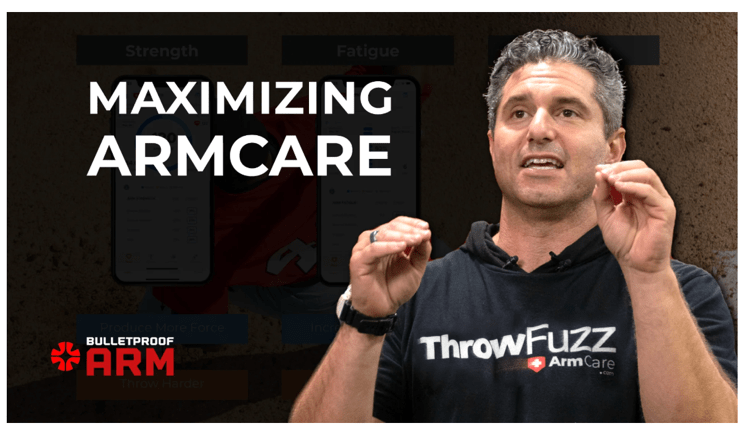
1. Bulletproof Arm Series – Maximizing ArmCare
Failures and Successes: Jordan Oseguera, our Director of Pitching Performance and Sales, and I worked together for a bunch of years with the Los Angeles Angels in various high-performance roles with pitchers. Much like a Football Head Coach takes his strength coach with him to the next gig, Jordan had to be part of the excitement building around our company.
He worked with Tom House previously, one of the most decorated innovators in baseball, and, between his experiences with Tom and what we have gathered through our professional experience and education, we found that pitch count standards are generalized and ineffective at protecting athletes from injury.
They must be individualized, and we continue to refine our alert system – but we built a process based on objective data – insights based on understanding years of poor recovery, fatigue, and imbalance signals.
Course Overview: This foundational course (65 min) introduces learners to the core ArmCare platform, emphasizing fatigue monitoring, workload scaling, and player development optimization.
Key Benefits:
- Gain an understanding of how to monitor throwing-arm strength, range of motion, and fatigue daily.
- Learn the mantra “Strength Matters Most” and why maximum strength influences performance and recovery.
- Equip yourself to identify compensations and early signs of overload before they become injuries.
Ideal For: Coaches, parents, players starting their data-led coaching journey.
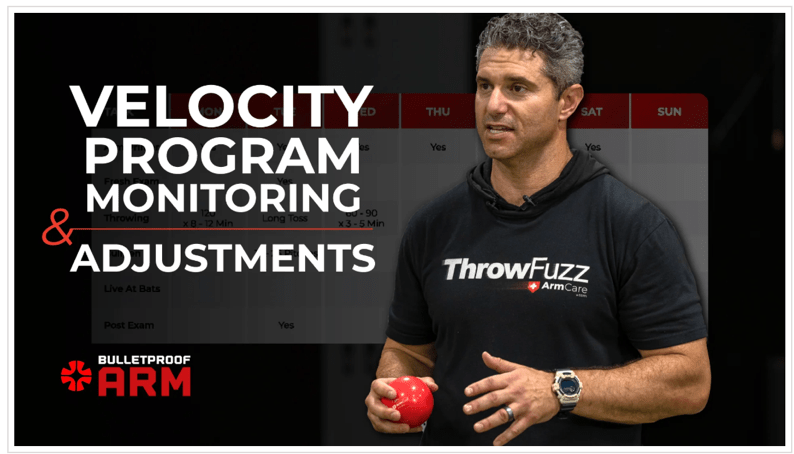
2. Bulletproof Arm Series – Velocity Program Monitoring & Adjustments
Failures and Successes: Before Jordan Oseguera, I, and a bright physical therapist teamed up, the Angels had 25% of athletes who entered the high-intensity program suffer arm injuries, with about 5% needing surgery within the calendar year or the year after graduating.
With a dedicated process for examining multiple metrics in our athletes, identifying traits that led to high success, and, of course, routinely evaluating throwing-arm function to scale workloads and training, our program became injury-free and produced MLB talent.
Overview: This 110-minute advanced class delves into velocity enhancement mechanics, programming approaches, and how to adjust programs using data insights.
Key Benefits:
- Discover how to manage training volume, intensity, and implementation of weighted implements through objective metrics.
- Understand when a player is not ready for a velocity-enhancement program to reduce injury risk.
- Gain insight into the force-velocity relationship and how it applies to throwing arm power vs. injury risk.
- Ideal For: Strength coaches, players & pitching coaches seeking to safely enhance velocity.
Ideal For: Strength coaches, players & pitching coaches seeking to safely enhance velocity.
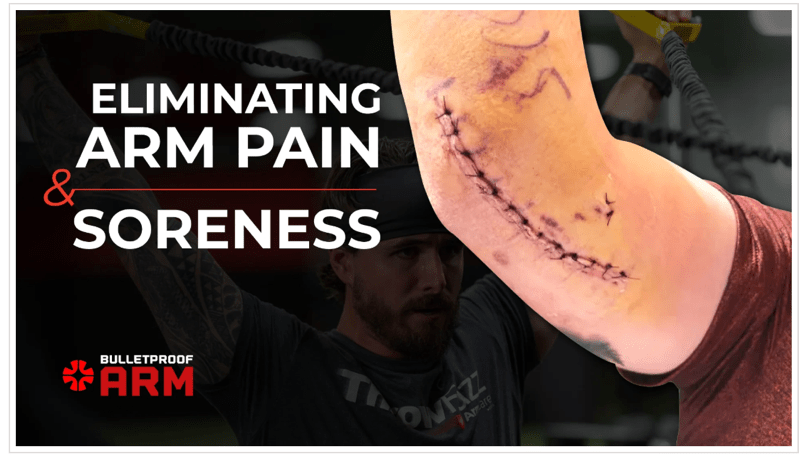
3. Bulletproof Arm Series – Eliminating Arm Pain & Soreness
Failures and Successes: My first role with the Angels was the Player Performance Coordinator. Due to being short-staffed, I had to fill in at times as the Return-to-Performance Strength Coordinator. I was in on all conversations as they related to pain and soreness, injury, re-injury, and return to competition. As a result of working closely with athletes in pain, many of whom had secondary surgeries, I learned a lot from the players and staff about how to define pain and soreness, treat them, and develop an algorithm for attacking them.
Course Overview: A 100-minute course focused exclusively on pitchers’, position players’, and throwers’ arm soreness, pain mechanisms, imbalances, and innovative intervention strategies.
Key Benefits:
- Learn to recognize early arm-care issues (strength deficits, scapular dyskinesis, fatigue markers).
- Apply the 48-Hour Rule to act swiftly when soreness or stiffness appears — supporting longer careers.
- Understand the roles of strength and mechanics in preventing pain and surgical injuries, and how to build a player back up after a stoppage in throwing.
Ideal For: Athletic trainers, physical therapists, and coaches tied to player health.
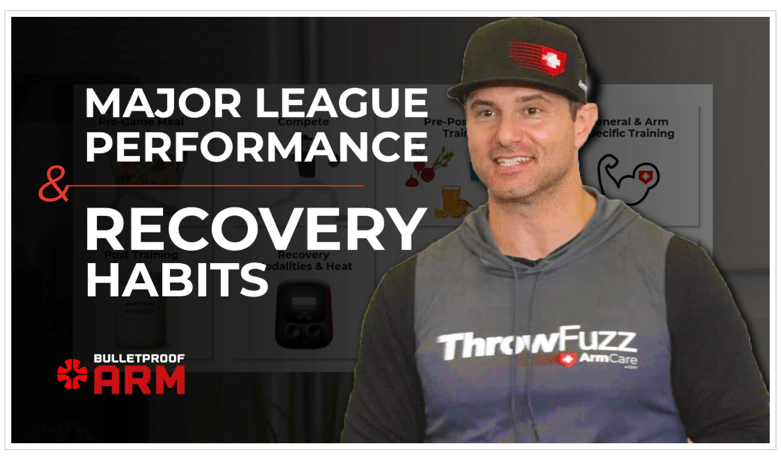
4. Bulletproof Arm Series – Major League Performance & Recovery Habits
Failures and Successes: When promoted to the Director of Performance Integration, I realized that we had missed huge wins off the field. With one dietitian and our assistant MLB strength coach undergoing education to become an RD, I quickly saw the benefits of micronutrients for the throwing arm. Circulation and inflammation are either hurt or helped by our habits. In researching the ulnar collateral ligament, the part of the body repaired in Tommy John Surgery, it was clear that the part of the ligament with no chance of surviving conservative treatment is the attachment, which is extremely deficient in blood flow.
This holds true for other mild to severely avascular regions of the throwing arm. Our athletes get enough macronutrients (protein, carbohydrates, and fats), but minerals and vitamins to support chemical reactions that open pathways for microcirculation are a different story. We saw circulation issues during our strength testing, which hold true today with our product and platform. Look at the recovery score next time on our platform and see this interaction in action.
Course Overview: This 75-minute class covers the “Great-8 Performance Process” — nutrition, sleep, hydration, circulation — elements essential for high-performance throwers.
Key Benefits:
- Understand macronutrient, recovery, and sleep habits that support elite pitchers.
- Learn how to protect the throwing arm via systemic recovery (not just arm-care workouts).
- Improve durability, shorten recovery timelines, and minimize wear-and-tear across the season.
Ideal For: Players, coaches, and support staff aiming to elevate whole-body durability.
5. Bulletproof Arm Series – Data-Led Pitching Management
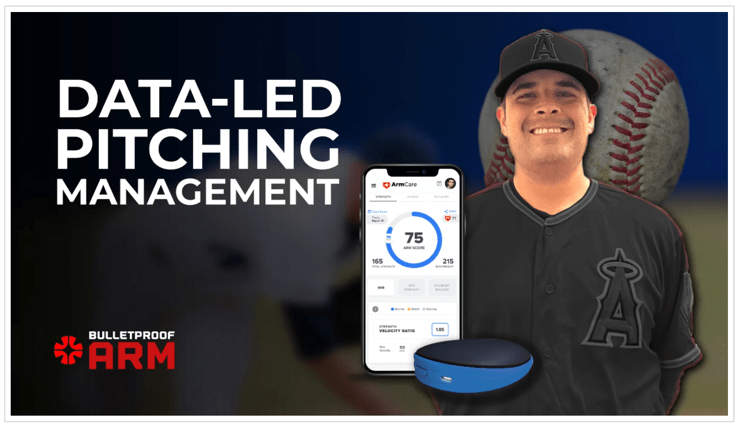
Failures and Successes: With the Angels, I walked into a team that had the most pitching injuries in the Major Leagues for two consecutive years. We learned that pushing range of motion and mechanics was not the way. It did not make our situation better; it made us worse, with wild changes in motor preferences without a system, and made players too loose without the strength to stabilize an expanded range of motion. We had to identify where to focus, properly place training, create balance to address range-of-motion imbalances, structure to avoid overworking the arm, and appropriately place recovery, prioritizing those days in the weekly competitive schedule first.
We go through many different plan options for pitchers at a variety of levels, how to integrate testing and reordering training, reworking workload aspects, and managing throwing arms, all covered in a great course that is under an hour long.
Course Overview: A 45-minute course teaching individualized in-season pitching schedules and analytics for managing fatigue, workload, and performance.
Key Benefits:
- Build individualized, data-driven throwing plans (not cookie-cutter programs).
- Use daily strength tests and arm-data alerts to make tactical decisions around bullpens and starts.
- Reduce injuries and improve performance by aligning throwing and training loads with readiness.
Ideal For: Pitching coaches, performance directors, and front-office personnel.
6. Bulletproof Arm Series – Building Data-Driven Throwing Programs
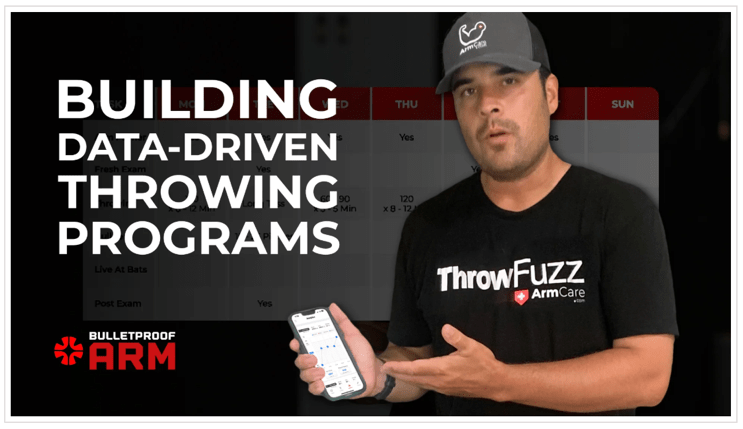
Failures and Successes: My first year with the Angels, I didn’t want to make too many waves in the offseason, but boy, did Jordan and I have many conversations about the offseason throwing programming. Forget whether we had a good plan or not, 99% of our players were not following what was on the PDF and were going elsewhere, working with people who could have cared less about having a conversation with us. The communication breakdown and lack of individualization was very apparent, but not to mention the development of programming based on exponential workload, especially under tight time frames (bullpens starting in December, serious ramp up in throwing volume and intensity together).
The GM was forward thinking and provided a lot of support, and the pitching staff were very open to changing some things up as most of our injuries were occurring in Spring Training, this is true for everyone as it is either an underload or overload problem with acute stress.
We treated the throwing program as a non-linear pattern, and therefore, the workload design looked much like the stock market graphically, and not a staircase with more throws, more intensity and more frequency.
Course Overview: This 100-minute course empowers coaches and athletes to create highly individualized throwing programs anchored in strength testing and biomechanics.
Key Benefits:
- Learn how ArmCare’s “Arm Primer” daily test feeds live data into throwing-program adjustments.
- Understand how to manage secondary pitches, long toss, and build a 16-week offseason plan rooted in external-to-internal workload translation.
- Connect strength metrics (SVR, arm-to-body ratios) to workload and program design.
Ideal For: Advanced coaches and athletes dedicated to elite, personalized throwing development.
7. Certified ArmCare Specialist (CAS) Course
Failures and Successes: This one is deep. It comes from years of science and a lot of head-butting, a lot of not-staying-in-your-lane, which is traditionally the way in MLB. We, as a group, oppose sticking to what you know and who you are, and a science guy like me, with a practical background as a strength coach, generally must stay out of the medical side. Even more challenging was Jordan’s involvement as a pitching coach, who, in fact, has the most critical role in player health by setting the standards for workload, pitching management, and specialized programming.
For two years, leading the league at both the Major and Minor League levels in arm injuries, we tried to combat the issue with more arm-care training. We took a role that more is more, when less is more, and better is better… but what is the right amount? When I was the Director of Performance Integration, I worked with our Medical Director to define what poor function means, we brought in sophisticated strength testing equipment, that is now in the palm of your hands from our company, and we saw trends, we understood arms, and our growth mindset and communication grew – we built individualized changes for players and were able to reverse the curse. We had become one of the best teams for player health – a full-team effort and the only team during COVID that did not have a surgery amongst any active roster players. We tested the arm like crazy from the get-go. Didn’t pitch all that well, but we dominated in durability!
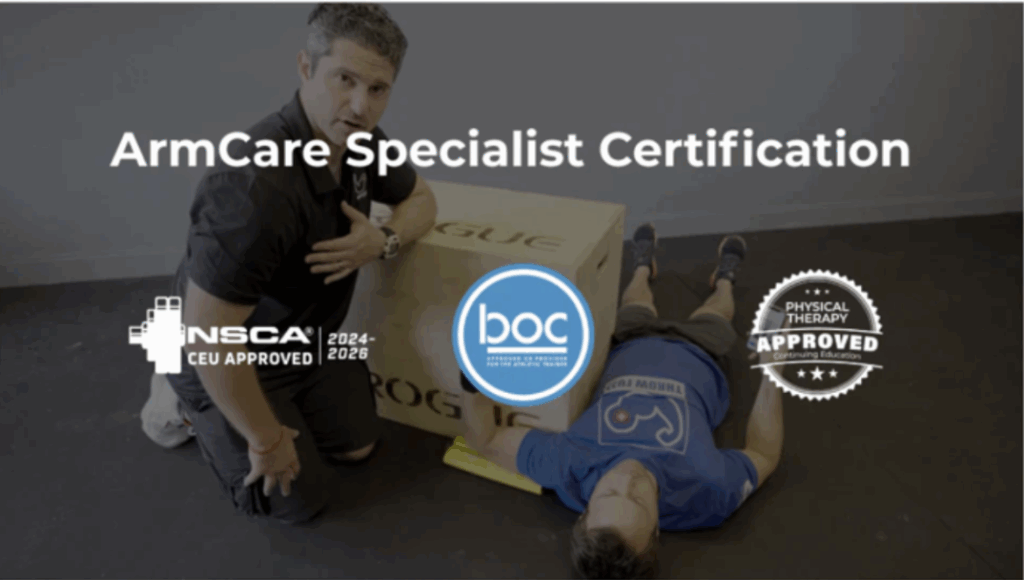
Overview: A profound certification teaching approved by the NSCA, BOC, and APTA on how to interpret strength, range of motion, and fatigue data, and personalize training as a specialist.
Key Benefits:
- Become proficient in: assessing arm strength (ArmScore), fatiguability, ligand-stress tolerance, and return-to-throw readiness.
- Drive targeted interventions—strength training, neuromuscular conditioning, throwing scheduling—based on objective data.
- Develop a prevention-first mindset: stronger arms, fewer injuries, longer careers.
Ideal For: Strength coaches, athletic trainers, pitching coaches, and high-school/college programs wanting a competitive edge and a commonplace in speaking about players’ throwing arms – no need to stay in your lane because you understand how the highway works.
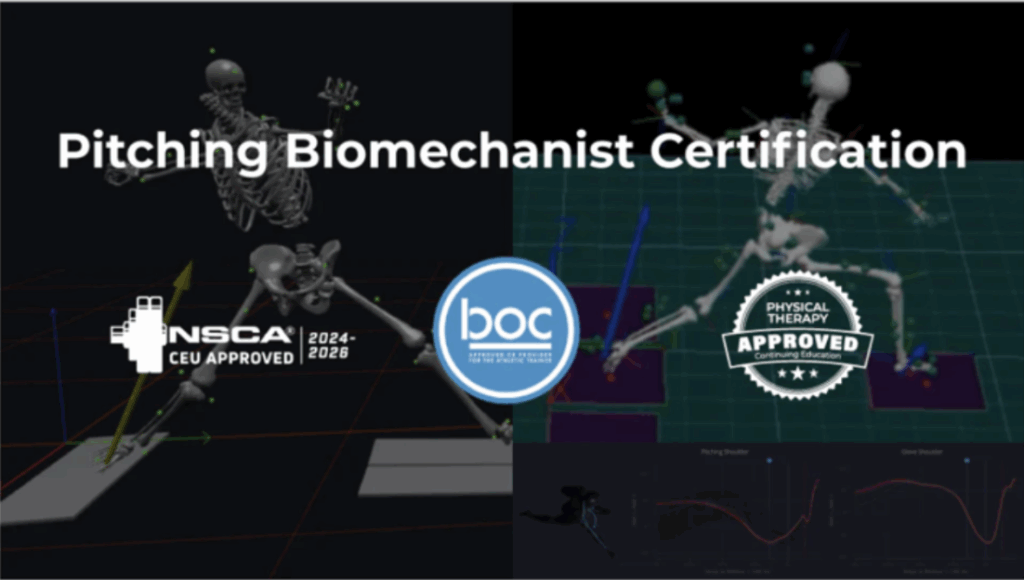
8. Certified Pitching Biomechanist (CPB) Course
Failures and Successes: You are going to have the baby without the excruciating labor you endured. I am sharing key information with you that came with plenty of frustration, dead ends, and a lengthy dissertation. Over approximately 7 years of PhD work and a postdoctoral fellowship in orthopedic sports medicine focused on throwing-arm injuries, I was on a journey to become a fatigue-induced injury expert in baseball. To gain this expertise, one must be an exercise physiologist and understand the human body’s internal and functional responses to throwing stress. I examined saliva, blood, urine, and post-throwing strength from many players. On the flip side, mechanics-based elements altered by fatigue had to be examined, as compensations raise joint torques and forces that overload critical stabilizers of the shoulder and elbow.
When I met Jordan, I knew I had someone interested in movement quantification, and long before markerless motion capture hit the mainstream at stadium scale, Jordan quantified just about every pitch of every game. Many did this, ramping things up to overdrive.
In this course, we discuss stabilizing and destabilizing the delivery, propose a method to safely alter mechanics, define delivery efficiency, and teach how to analyze complex data and simplify approaches through case studies and applied technical and practical insights.
Overview: Approved by NSCA, BOC, and the APTA, this advanced biomechanics certification teaches movement profiling, compensations, motor-control strategies and how to remediate or progress pitchers based on mechanics and data.
Key Benefits:
- Decode how shoulder, elbow, trunk and lower-body sequencing affects fatigue, torque, and injury risk.
- Integrate daily strength tests with 3D biomechanics and throw tracking to provide truly tailored coaching.
- Teach players to master efficient mechanics, training strategies, and preserve their arm throughout a long season and apply the information to a variety of motion capture tools
Ideal For: Performance analysts, biomechanists, pitching coordinators, and clinics.
Dual Certifications (or Bundle) – Become ArmCare Elite
Failures and Successes: There’s so much knowledge to be gained from mastermind groups. People who test the limits of information, add to existing work, and have a growth mindset. Our ArmCare Elite classes are called scrums because we expect our students to be leaders. They truly are elite, and we hope they grow their own communities to share new insights and bring people together to advance health and performance in sport. Each year, 4 classes are built on a variety of topics, and we would love to have you join a special group that is right now a touch under 500 people.
- Individualization: Each athlete receives programming tailored to real-time data (strength, flexibility, fatigue) rather than a one-size-fits-all approach.
- Workload Management: These courses teach you to monitor and adjust training/throwing loads intelligently — reducing under-training and over-use.
- Program Design: Learn how to build throwing and strength coordination programs in sync — improving mechanical efficiency and reducing injury risk.
- Durability Focus: Strength, recovery habits, and neural fatigue mitigation are covered deeply — no more winging it with gut feel.
- Throwing-Arm Health Priority: Combine strength analytics, biomechanics, and workload tracking to keep athletes available and performing their best.
The Great Debate – Mechanics vs. Strength will be added next month. We go to battle over what is the most important factor in reducing injuries. Eugene Bleeker and I got at it and some people said it was like watching a train wreck, so it must have been good. He’s one of the brightest minds in the game and doesn’t back down, which I love about him. Nearly 2500 watched this, which is unbelievable.
Key Takeaways
Whether you’re a coach, trainer, therapist, parent, or player, ArmCare’s educational ecosystem gives you the tools to monitor, individualize, and optimize — from mechanics to strength, recovery to pitching scheduling, and much more.
Do you have the growth mindset bug yet?
If you do, you are on the path to building more durable players, smarter coaching strategies, having a recruiting advantage in building teams, but not just your players, but you yourself.
You will be on a clearer path to long-term success when you embrace the statement, “You can never know everything, and we must seek out information to help our athletes improve.”
Strength Matters Most Folks, and Strength Comes from Growth (Mindset)
Ryan
Ryan@armcare.com