

Strength in Numbers #145
Catch up on Part 1 of this series here.
With any client I take on, I first ask for a full biomechanical review of what they had been doing or had been coached for a year prior to an injury.
With Tejay, I captured a lot from social media and online by comparing deliveries, and then, in a detailed conversation, we went through many of the changes he made.
In all honesty, his mechanical approaches took his velocity to 100 mph, which presents risk and significant rewards.
Simple physics has shown that a 90-mph hour fastball leaves the hand and hits the glove in 400 milliseconds. The batter has 200 milliseconds to decide and only 200 milliseconds to get a swing off.
A 100-mph fastball can reduce the hand-to-glove time to below 400 milliseconds, shortening the time window to recognize the pitch and rush swings.
Here is a solid mechanical breakdown of Tejay’s mechanics by Ben Brewster from Tread Athletics, a partner company that has integrated our technology into their pitching development programs.
The video above provides a solid mechanical breakdown of Tejay’s mechanics by Ben Brewster from Tread Athletics, a partner company that has integrated our technology into their pitching development programs.
Tejay had his second Tommy John in 2021, which came after the shortened season that may be associated with previous mechanical changes. However, you will see there’s more to the story below on why players get hurt. Interestingly, it has very little to do with movement but rather the fatigue-induced consequences that arise from strength issues.
After viewing the video and discussing biomechanical history, I started putting some wheels in motion to explain why these elbow injuries crept up.
My first clue was at 12:55-13:15 in the video link above.
External rotation and scap retraction increased, which are two important elements in throwing hard with less relative elbow torque per MPH (ref).
Although Biomechanical Efficiency could have gone up (throwing faster with relatively less torque), the high octane coming from increased speed in stretch-loading the arm puts a heavy load on the catapult, and the springs need to be checked.
TAKING A FIRST EXAM AFTER BIOMECHANICAL REVIEW
When an athlete has a tighter and shorter arm path, the layback speed can often increase internal rotation torque needed to slow the arm down and stabilize the shoulder at maximal external rotation.
Think of the catapult analogy again: the catapult is being pulled back fast and further, so the springs, being your internal rotators of the shoulder and your forearm muscles, must be strong enough to control the layback.
If they are not, the ulnar collateral ligament (UCL) is exposed to greater stress associated with Tommy John Surgery. With Tejay, a high-octane pitcher, this can be even faster with the arm closer to the body, as trunk rotational speeds can also increase.
Things can get complicated when a shorter arm path and a faster-moving trunk have the hand inside 90 degrees of elbow flexion (the ball closer to the ear).
Some athletes lose Biomechanical Efficiency as they prematurely extend their elbow through maximal external rotation, which adds to greater varus torque (medial elbow joint torque) that is applied by the stabilizers of the inner elbow to protect the UCL and resist it from being overly stretched.

If you think you are seeing double, you are not. These slides are both from our Certified Pitching Biomechanist Course.
Note where the peak force for the shoulder and inner elbow occurs.
They both happen very close to each other, and both occur before the arm is in full layback, meaning that control of layback acceleration is a key piece in protecting the UCL in addition to the strength of muscles that overlay the UCL in shielding it from high rates of tension.
PATHOMECHANICS – WTF IS THAT?
Simply put, when biomechanics can turn ugly and cause injury, they form pathologies like Tommy John Surgery. Biomechanics that cause pathologies, like a ruptured UCL, are called pathomechanics.
What is pretty scary is that 99% of the world believes that biomechanics are the cause of these injuries, but research has shown that there is ZERO difference between pitcher’s mechanics who have had TJ surgery and those who have not.
Equally interesting is that healthy and injured groups had the same shoulder range of motion. Therefore, restrictions in passive range of motion may not be the most accurate form of injury surveillance for pitchers.
This makes the focal point of preventing injuries something other than range of motion and biomechanics. We need to understand the driver of pathomechanics when biomechanics present a risk of injury, which comes with fatigue, poor recovery, weakness, and imbalances in strength.
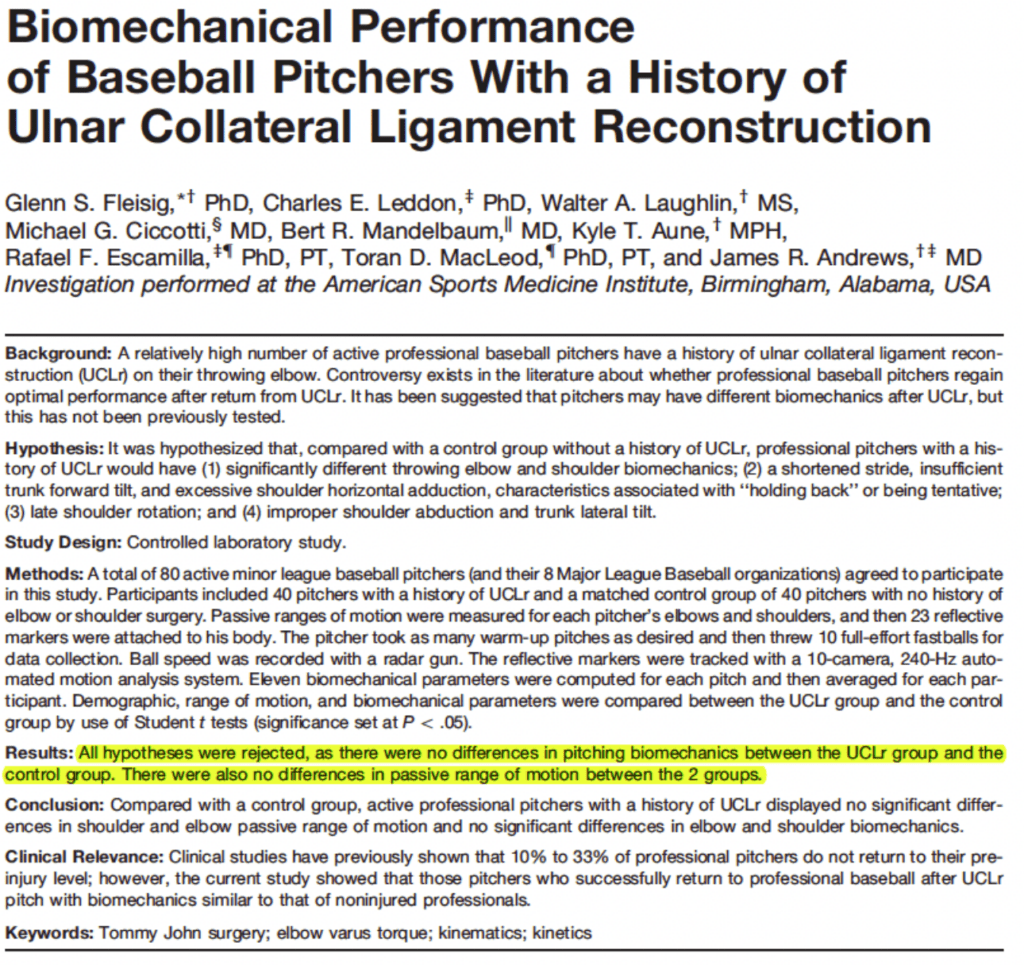
It’s pretty straightforward here. I highlighted the results.
Given that you understand the catapult concept, most pitchers who experience Tommy John Surgery, at least at the professional level, have grip strength less than 15% and a ratio above 1.05.
That means the muscles fighting against opening the elbow are exposed to weakness, and the back of their shoulders are so strong that the internal rotators cannot put on the brakes often enough to coordinate those high eccentric torques that we saw in the first slide, which occur in the transition of laying back the arm to its maximal external rotation position.
The difficulty with Tejay and many pitchers who have had revision surgery is that any change in strength may significantly impact deceleration, both in laying back the arm and resisting the opening of the inner elbow.
This is why the Post-Exam using the ArmCare platform after pitching is so important. These athletes will show reduced internal rotation strength after pitching and minimal change in external rotation strength.
Combined with reduced grip strength, that spells trouble. What frightens me even more is that, given the previous study, mechanics may look the same without any change in layback speed but could have a significant impact with muscle weakness.
Therefore, if you are in the biomechanics camp and searching for compensations, you may not see them.

Pictures are worth 1000 words, but I want you to see the video walk-through of training concepts and animation associated with the strength data above indicated by a player who presents internal rotation weakness/fatigue, low grip strength, and a high ERIR ratio, or Shoulder Balance Score.
Throwing hard and throwing healthy is the key. If you are looking at how to control pathomechanic consequences, trust your arm data and fix it.
More to come, and like I said, Strength Matters Most.