Strength in Numbers – 276
Baseball loves rotational power.
We train hitters to rotate faster, generate more bat speed, and transfer more energy into the ball. Medicine balls, rotational cables, and high-velocity swings have become staples of hitting development.
But there’s a problem.
We spend enormous amounts of time training athletes to accelerate rotation, yet comparatively little time teaching them to control and decelerate it.
When the rib cage becomes the weak link, intercostal strains can disrupt an otherwise productive season.
What Are the Intercostals?
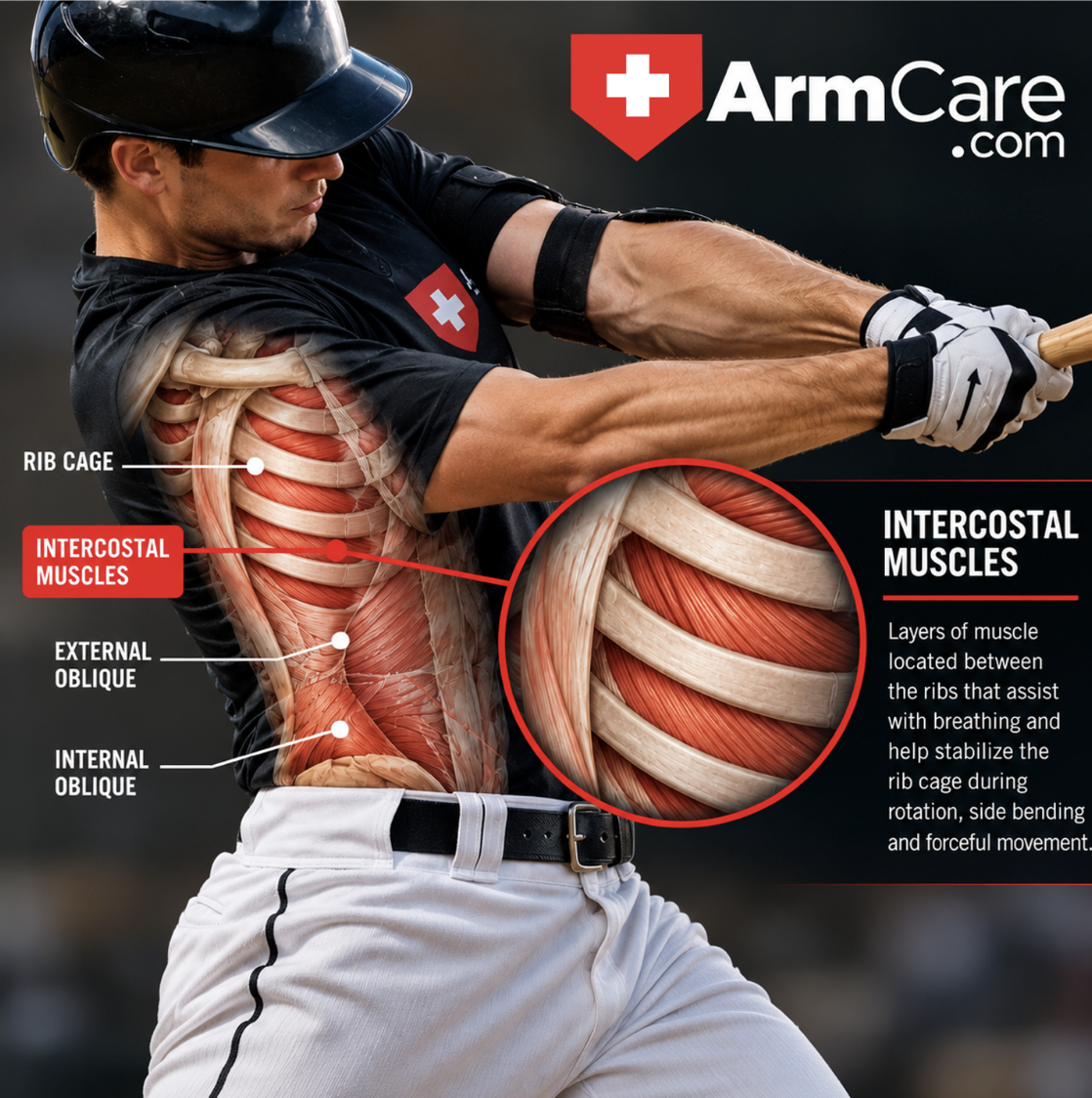
The intercostals are layers of muscles located between the ribs. Their primary roles include supporting the chest wall and assisting breathing, but they also face mechanical demands as the trunk bends, rotates, and responds to forces generated during athletic movement.
Unlike the large abdominal muscles, the intercostals aren’t designed to drive powerful trunk rotation.
However, they must accommodate the rib cage’s changing positions and forces as the pelvis, trunk, and shoulders accelerate through a swing.
The faster the trunk moves, the more important it becomes to control how that movement starts, transfers, and stops.
How Do Intercostal Strains Happen?
Intercostal strains can occur when the muscles between the ribs experience excessive tensile loading, particularly during forceful trunk rotation, side bending, or sudden changes in movement.
In hitters, several situations deserve attention:
Aggressive trunk separation: Large or rapidly developed differences in pelvis and trunk rotation can increase demands on the tissues surrounding the rib cage.
Uncontrolled follow-through: Rapid rotation without coordinated trunk deceleration may place additional mechanical demands on the rib cage.
Late swing adjustments: Reaching for outside pitches, checking swings, or reacting to unexpected pitch locations can introduce abrupt changes in rotation and side bending.
Accumulated swing volume: Repeated high-intensity swings, especially during fatigue, can increase exposure without adequate recovery.
These are plausible loading mechanisms, not proof that any single swing characteristic causes an intercostal injury.
The Missing Half of Rotational Training
Consider a hitter performing hundreds of rotational medicine-ball throws, cable rotations, and high-intent swings every week.
Almost everything is designed to make him rotate faster.
But what is training him to stop?
Rotational acceleration creates the movement. Rotational deceleration helps control it.
The obliques, spinal musculature, abdominal wall, and other trunk stabilizers must coordinate to transfer and manage forces between the lower and upper body.
When training emphasizes acceleration without sufficient attention to eccentric strength, anti-rotation control, and trunk stability, an important physical quality may be underdeveloped.
And there’s another issue…workload.
A hitter might take 50 swings in practice, 75 in the cage, and another 100 during private training.
That’s 225 swings in a day, not including warm-ups, weighted bats, or rotational strength exercises.
Not all swings create equal demands, but they all contribute to the athlete’s overall exposure.
We count pitches. Why aren’t we more intentional about counting swings?
What Should Hitters Train Differently?
The solution isn’t to eliminate rotational power training.
It’s to develop a more complete trunk.
1. Build rotational strength. Train the ability to produce force through coordinated pelvis and trunk movement.
2. Develop deceleration capacity. Incorporate controlled eccentric rotation, anti-rotation exercises, and positions that require the trunk to resist unwanted movement.
3. Train multiple planes. Include lateral trunk strength, controlled side bending, breathing mechanics, and rib cage positioning, rather than training transverse-plane rotation exclusively.
4. Manage swing workloads. Track total swings, high-intent swings, weighted-bat work, and additional rotational training. Progress exposure based on the athlete’s preparation and response.
5. Monitor the response. New rib pain, pain with deep breathing, coughing, or rotation, and changes in swing mechanics warrant attention rather than more repetitions.
Persistent or significant rib pain should be medically evaluated because not all rib-region pain represents an intercostal strain.
Takeaway Message
Hitters don’t just need the ability to rotate quickly.
They need the strength and coordination to manage rotation throughout the entire swing.
That means accelerating, transferring energy, controlling trunk position, and decelerating without asking one region of the body to compensate for what the rest of the system cannot manage.
Bat speed tells us how fast the system moved. It doesn’t tell us how well the system controlled that movement.
To sum up the action steps, we built this video around the need for rotational training for pitchers, but for hitting, the Torq system is the go-to for developing core control, decelerative strength, and more.
For more, check out this video on resisted rotational training.
Strength Matters Most.
Ryan
Ryan@armcare.com