Strength in Numbers – 275
Biomechanics can be a scary word, and one that I have researched, published on, and put into our courses.
It goes without saying, everyone wants better pitching mechanics. But what if the movement you’re trying to correct isn’t the problem? Worse, what if you visualize something that doesn’t look right and you disrupt the delivery or make it less deceptive?
What if it’s a compensation for the force your athlete can no longer produce?
That’s why the two Ks of biomechanics change how we evaluate pitchers.
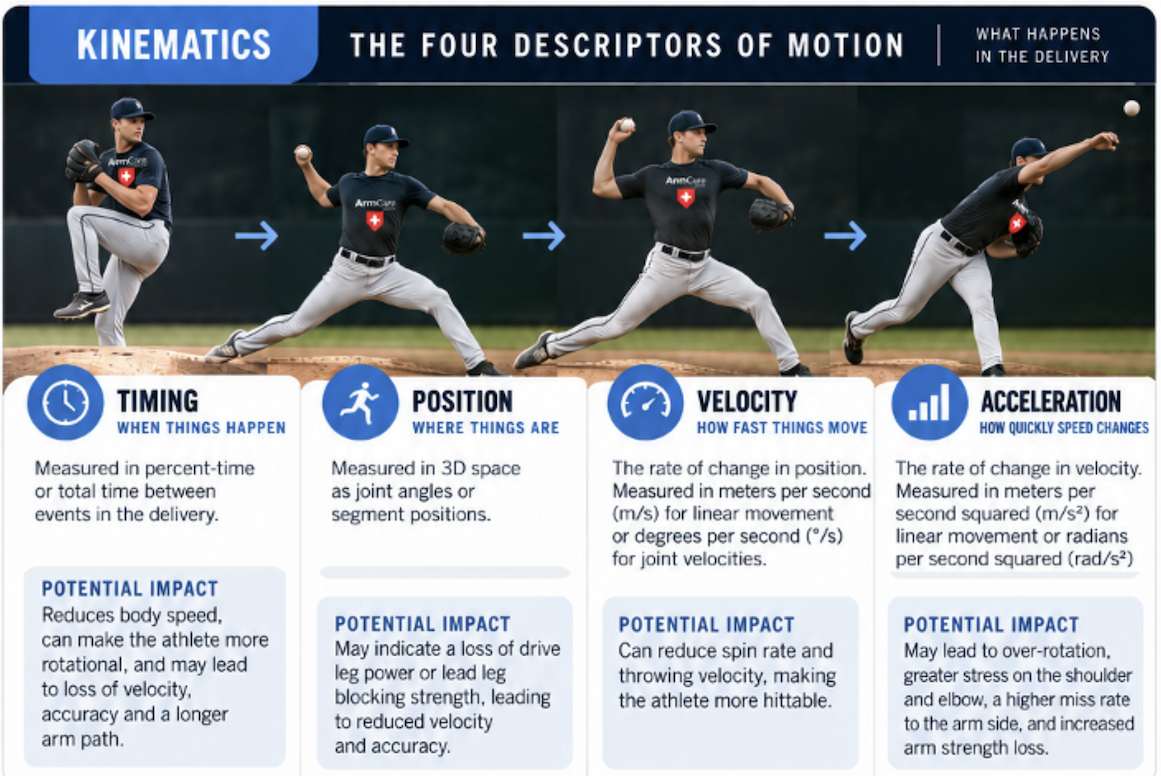
K #1: Kinematics — What the Body Does
Kinematics describes movement through four measurable features:
- Timing: When does the lead foot contact the ground?
- Position: How long is the stride? Where is the arm?
- Velocity: How fast do the trunk and throwing arm move?
- Acceleration: How quickly do body segments speed up or slow down?
These are the things we see on video and measure through motion capture.
A shorter stride, dropping arm slot, or slower trunk rotation might look like a mechanical problem.
But kinematics tells us what changed, not necessarily why.
K #2: Kinetics — The Forces Behind the Movement
Kinetics examines the forces and moments associated with motion.
The foundational relationship is:
FORCE = MASS × ACCELERATION
And when force acts around a joint, we evaluate its rotational effect as torque.
Here’s why this matters.
Imagine a pitcher whose lower-body force production declines during an outing.
His stride may shorten, his center-of-mass speed may decrease, his lead-leg blocking may change, and his arm timing may shift.
You could spend hours coaching the movement you see.
But if reduced force capacity is contributing to those changes, a mechanical cue alone may not solve the underlying problem.
That’s why strength testing and motion capture are more informative together than either is alone.
When Velocity Increases, What Else Changes?
As athletes grow and throw harder, pitching forces can increase.
That doesn’t make velocity bad. It makes physical development important.
Two relationships deserve attention:
Strength-Velocity Ratio: How much throwing-arm strength does an athlete have relative to the velocity he produces? We keep pushing for 2.0 lbs/mph because, in our experience in pro baseball, anything below that could increase the risk of strains, sprains, and arm pain. To make it simple, if you throw 100 mph, aim for 200 lbs of total arm force.
These relationships encourage a better question than simply asking whether velocity increased……
Did the athlete’s strength and force-producing capacity develop alongside his performance?
The SVR does not predict injury alone, and the framework for interpreting performance is beyond the radar gun.
The Takeaway Message
This is why we combine strength dynamometry with biomechanical information.
Motion capture helps us identify how movement changes – we teach this in our Certified Pitching Biomechanist Course.
Strength testing helps us investigate whether physical capacity may be contributing to those changes.
Together, they help coaches make more informed decisions about what to train, what to monitor, and when to reassess.
Measure what matters. Understand what changed. Train what needs improving.
That’s the real value of knowing the K’s behind K’s.
Get a couple of quick tips on kinematics and kinetics here:
Strength Matters Most,
Ryan