Strength in Numbers – 249
I’ve reviewed hundreds of training histories from athletes—especially those coming off surgery.
And there’s a consistent pattern…
Forearm training is either missing or incomplete.
Even when it’s included, most athletes focus heavily on wrist flexion (curls, grip work) while overlooking a critical piece…Pronation.
That matters because the forearm isn’t just about size—it’s about function across the entire system.
You can build big forearms and still leave both velocity and elbow health on the table.
Why?
Because the flexor-pronator mass isn’t just a “flexion” system, it’s a dynamic stabilizer of the elbow, especially under high-velocity throwing.
And if you’re only training one side of that equation, you’re leaving protection—and performance—untapped.
Why Pronation Matters
The forearm flexor–pronator mass (including the pronators) is a primary stabilizer of the elbow, especially the structures that protect against stress at the UCL.
If this system is underdeveloped:
- The elbow absorbs more stress per throw
- The arm struggles to decelerate safely
- Velocity gains become less sustainable
In math terms….
Strong pronators = better force transfer + better protection
How Our Pronators Impact Velocity
Velocity isn’t just about arm speed—it’s about how well you control and apply force.
Training pronation improves:
- Internal rotation support (key for endpoint acceleration and added friction)
- Ball release consistency
- Force direction through the forearm and hand
If you’re not hitting this in your programming, you’re missing a critical link in the chain.
Grab Your Bands and Get to Work
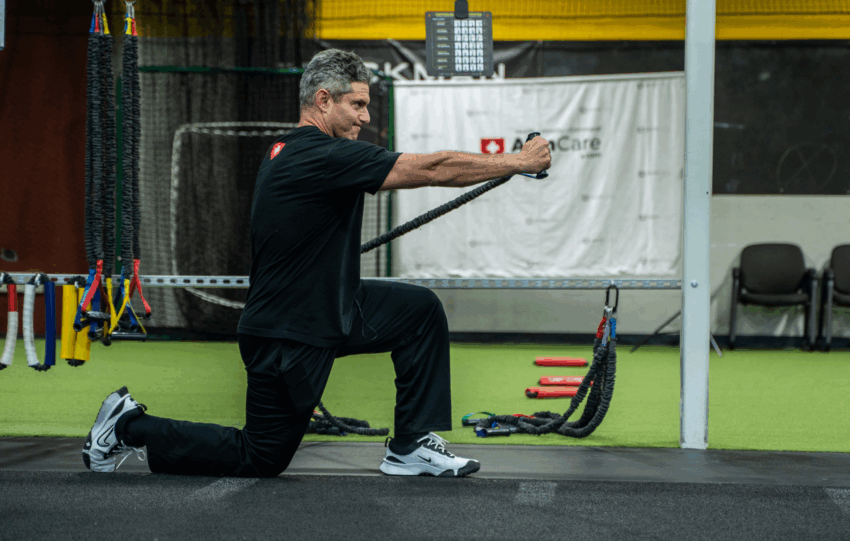
Using bands:
- Train pronation into flexion (turn the hand inward under tension)
- Vary grips: full grip, pinch grip, 3-finger grip
- Focus on intent and tension, not just reps
This will anatomically target big players in the elbow stabilization game, and they can activate in a coordinated fashion. Not to mention improving pitches that require more pronation, like a change-up.
The Takeaway
Big forearms don’t guarantee durability, and like your shoulders, you need to balance forearm strength and work in an important inner elbow stabilizer by training pronation.
If you want higher velocity, better recovery, and reduced elbow stress, I suggest you watch the video below.
Strength Matters Most.
Ryan
Ryan@armcare.com