

Strength in Numbers #227
We need to keep the conversation on Yoshinobu Yamamoto’s performance. The 2025 World Series was a showcase of durability, precision, and adaptability rarely seen in modern baseball, but may be considered a new norm in years to come.
In do-or-die situations, pitching on short rest — including back-to-back appearances — Yamamoto defied expectations, maintaining elite velocity and command despite condensed recovery windows. His performance provides a living case study in how physiological resilience, efficient mechanics, and structured arm health monitoring can sustain peak output under postseason stress.
In studying Japanese pitchers, including Yamamoto, it becomes clear that they are products of a system that emphasizes high work capacity, precision training, and recovery discipline. In Japan’s Nippon Professional Baseball (NPB), pitchers operate on a six-man rotation, granting an extra day of rest compared to MLB’s five-man model. They also engage in extended throwing sessions and meticulously monitored strength work, creating exceptional mechanical repeatability and endurance.
However, like our athletes in the US, they require thorough monitoring, as MLB players have a 4 times greater injury risk, and 5% of athletes will undergo arm surgery. Additionally, college players face a 20% risk of injury.
Let’s further the education on pitching with shortened rest.
Key Facts to Consider for Future Health & Back-to-Back Performance
As mentioned, transitioning to MLB introduces new risks. The Crotin et al. (2021) MLB–NPB comparative study found that MLB pitchers sustain injuries at more than double the rate of NPB pitchers due to shorter rest cycles, longer travel schedules, and greater game density – but even more frightening is the amount of secondary injuries.
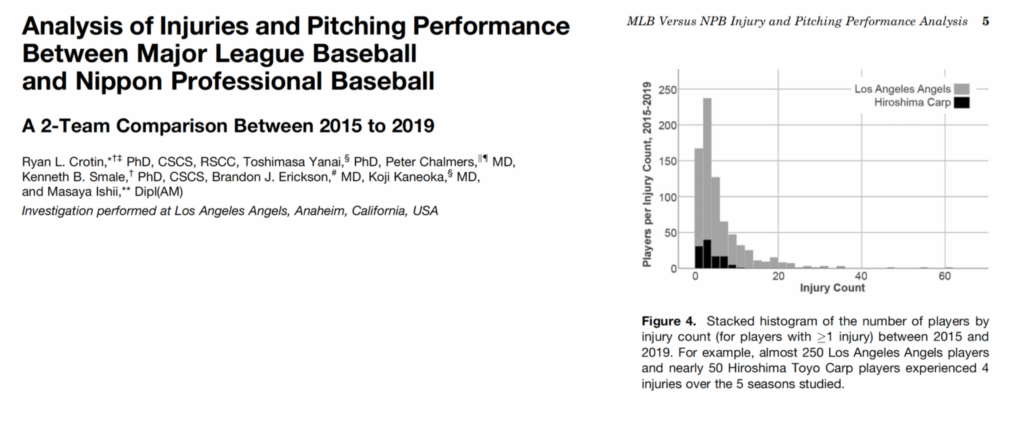
The injury data was quite alarming, revealing the historical injuries that occurred in players over the course of these seasons. What you can see is that the great majority of players in professional baseball have multiple injuries over the course of several seasons, and the Angels in 2019 were among the top-ranked teams for health. In 2017 and 2018, the team led the league in pitching-related injuries until arm strength testing and customized throwing programs were implemented.
In one of the best World Series displays ever, Yamamoto delivered 6.1 innings, averaging 95.1 mph on his fastball with a peak velocity of 97.4 mph. He threw 67% strikes on the four-seam fastball and held opponents to an average exit velocity of 88.5 mph.
Despite the threat of injury, he returned just three days later in the final game, despite having shortened rest. Despite the reduced recovery, his average fastball velocity dipped only slightly to 94.7 mph, with a peak still reaching 96.8 mph. His fastball strike rate remained steady at 65%, and batters’ average exit velocity against him climbed only marginally to 90.2 mph — a testament to his neuromuscular efficiency and refined movement control.
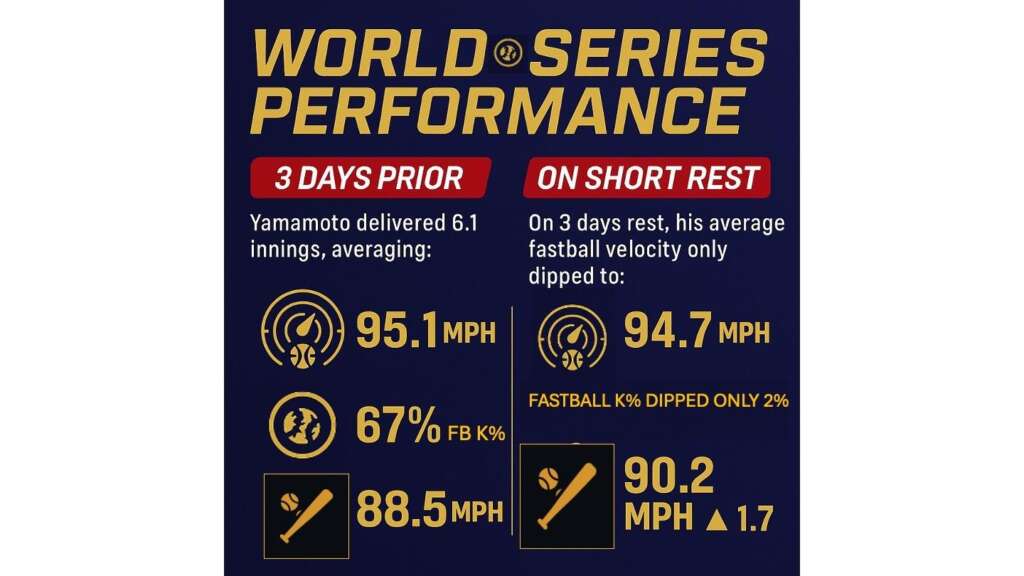
This consistency under fatigue conditions is exceedingly rare. Research conducted by Jordan Oseguera, Director of Sales and Pitching Performance at our company, Christian Conforti, Blue Jays Defensive and Baserunning Analyst, and I highlighted that elite pitchers typically experience measurable reductions in velocity and command during the playoffs due to accumulated workload and psychological stress. Yamamoto’s ability to resist this decline underscores the exceptional conditioning and adaptive strategies rooted in his Japanese development system.
Fielding-independent pitching decreases (represented as an increase, which indicates worse performance) as a measure of direct pitching production among the best pitchers. Yamamoto continued to perform well in the playoffs with less decline compared to the regular season. You can see the sharp rise in Excellent regular-season performers who suffer most during the playoffs, which may be attributed to throwing arm fatigue.
The ArmCare Approach to Pitching on Short Rest
Yamamoto’s success on short rest could be even more effective in aligning closely with ArmCare’s data-led principles for safely managing condensed recovery intervals. Our short rest protocols are unprecedented in baseball, especially since we established specific qualifiers before allowing pitchers to return to the mound.
We are developing a comprehensive course focused on the ins and outs of data-driven decision-making for pitchers, and one that is particularly crucial for returning athletes to compete at a higher level.
The flow chart below has numerous checks and balances, but we must ensure that we are making sound decisions when it comes to short rest. There is, however, more to this story, as coaches in college baseball have experienced great success by understanding their players’ throwing arms and prescribing shortened rest.
The flow chart on pitching with a short rest. It starts with being physically mature, mentally ready, having ArmCare metrics that check out, and feeling ready to go. Read more on the key ingredients below……
- Pitch Count Progression:
- Look at the flow chart, and if everything checks out, consider how much was thrown in the previous outing and factor in the amount to throw according to the rest provided. For example, if you threw more than 120 pitches, you need 3 days’ rest to hit 70 pitches in coming back to the mound.
- Strong Arm Qualification:
- ArmScore above 100, SVR (Stress Velocity Ratio) > 2.0, and no recovery or fatigue alerts
- No Fatigue or Recovery Alerts:
- Verified via Fresh Exam on game day and Post Exam immediately after previous outing.
- Athlete Feedback and Mental Readiness:
- Players must affirm, “My arm feels great,” aligning subjective confidence with objective strength data.
These metrics, when applied systematically, quantify readiness and reduce the injury threat associated with high-stakes, short-rest pitching. The system’s analytics mirror Yamamoto’s durability — an athlete demonstrating elite neuromuscular control, low fatigue accumulation, and consistent force output under postseason strain.
The complete picture creates confidence for athletes and coaches as they head into the playoffs.
Athletes fatigue in many different ways, but having objective data can indicate how neurologically wired they are – just check out a screenshot of a pitcher’s post-throwing fatigue rating – we want to see 100+ across as many muscle groups as possible.
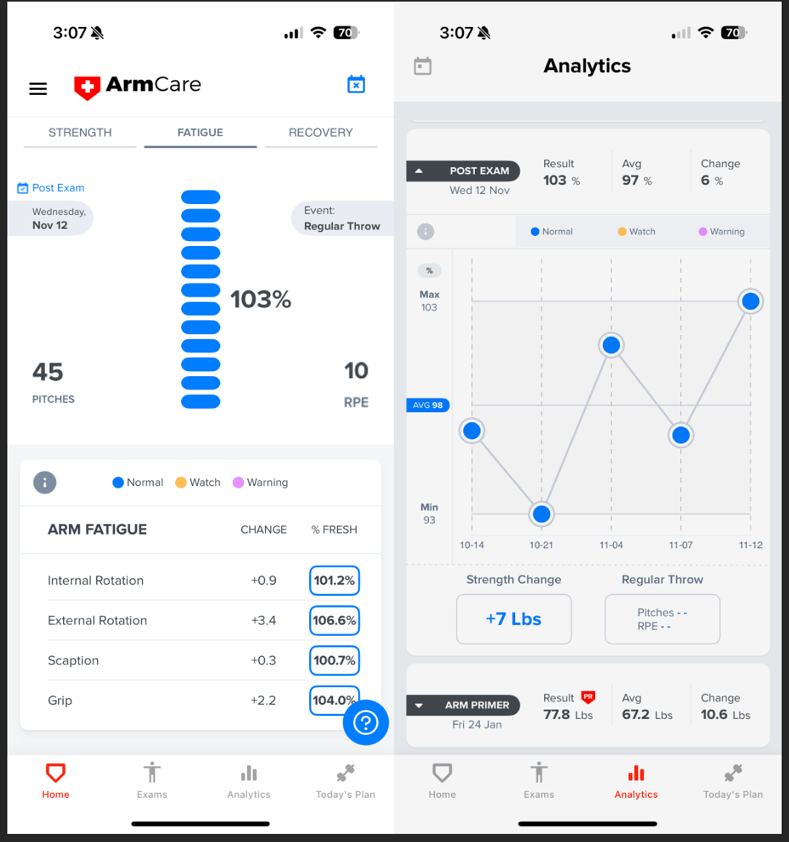
App images of an athlete who is neurologically wired and fatigue-resistant. Note that every single muscle is supercharged after pitching, and the trendlines on the analytics table show upward progress. All around great to see, as it relates to health and performance.
One of the things that works for some of my athletes who hit a stagnation point in their activation is to consider single-arm variations to create a boost. By studying your athletes’ activation process and responses after pitching, you can gain an edge and better understand how their arm responds.
This is just one nugget from our Certified ArmCare Specialist Course – an approach to blend strength and coordination, to prepare the body for explosive movement but controlled stability – this certification will open your mind to strategies to undertake when you may be scratching your head, why you’re not seeing arm strength gains.
We need to adapt. We need not only to survive but also to thrive under all sorts of competitive conditions. We need to be scientists, not those who wear lab coats, but rather those who wear baseball hats and have some unanswered questions.
Apply the teachings from our courses and understand how to combine data and art – doing so opens up a whole new world for you in maximizing your talent.
Key Takeaway
Yamamoto’s World Series heroics on short rest represent a fusion of Japanese precision, MLB resilience, and modern sports science. His outings demonstrated not only elite skill but also alludeludes to the physiological preparedness that ArmCare aims to help quantify across the bard— the capacity to recover, adapt, and dominate when the game is on the line.
When science meets preparation, pitchers don’t just endure short rest — they redefine what’s possible under it.