Strength in Numbers #132
(Read Part 1 Here)
You are making a big mistake. And I was, too, when I believed that the words “stressful” and “forceful” were the same things when it comes to the delivery.
I constantly hear from those who favor a mechanical approach, “We reduced stress in a pitcher’s delivery; that’s why he doesn’t have pain; that’s why he is going to be injury resistant.”
I have heard it my whole life and believed it until I saw that pitchers who had been considered to throw with “less stress” get hurt, and I mean a lot of them.
LET’S DIVE INTO WHAT IS STRESSFUL AND WHAT IS A FORCEFUL DELIVERY
One of the sections of our debate focused on this, as we predicted that the word “stress” would pop up at some point. That’s not to say that it’s exclusively a 108 Performance term, but it’s a world term, and we need to clarify.
To calculate stress, you must look inside the body and measure the cross-sectional tissue of the tendons and ligaments overlaying the inner elbow joint.
You must ask, how thick are the tissues? How stiff are they? And yes, HOW STRONG ARE THEY?
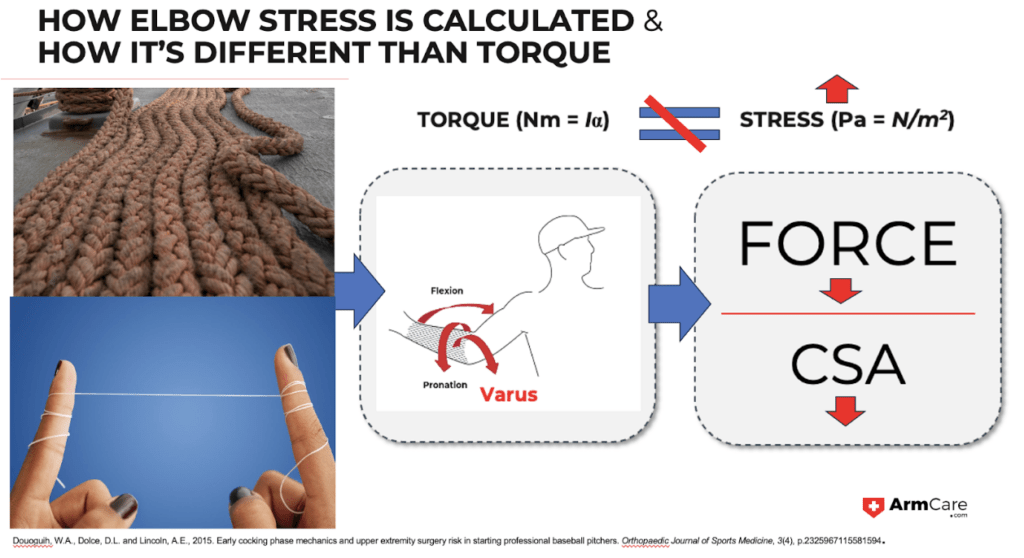
We usually measure varus torque in a pitcher’s delivery to assess the force on the elbow and the risk of injury. This force is easily calculated with 3D motion capture.
However, research does not support this notion, as only one study indicates that force was associated with torque, and we go off on it here.
The other thing that puts this concept of purely looking at mechanics in a vacuum (without fatigue-induced risk from strength loss) is that pitchers with TJ and those without TJ surgery are shown to have the same torque on their elbows.
Still not convinced, scan this abstract from the greatest biomechanist in the history of the world, Dr. Glenn Fleisig, and his staff who published the results. I want to take you on a different path, and it will be bumpy.
You see, it’s not force that is the problem; it’s the force applied to the cross-sectional tissue.
The calculation is on the right side of the slide above. Force divided by the cross-sectional area (CSA) of tissue IS MATHEMATICALLY EQUATED TO STRESS, and you have zero idea of the stress applied unless you calculate the dimensions of the tissues for the inner arm.
Now look at the examples above on the CSA side. Imagine you leave a pitcher alone who is performing well, pain-free, throws forcefully, and has the tissue thickness and strength that resembles the rope for a boat anchor.
You are likely going to see reduced stress.
Let’s say you take a guy with a “forceful” delivery with the same torque values as the previous pitcher. You make the decision to reduce the force with mechanical changes (hopefully not sacrificing velocity), but that athlete has a weak arm and reduced CSA, which could be likened to a piece of dental floss.
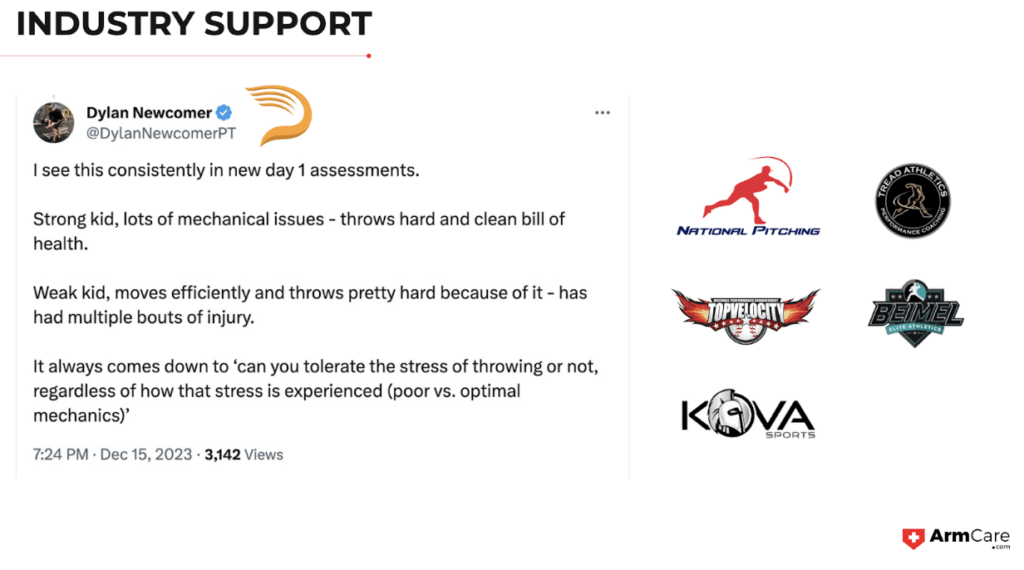
Well, you will see that the delivery has heightened stress even though you made the delivery less forceful. Hence, the post below says it all from Dylan Newcomb, Driveline’s head of physical therapy:
Is it starting to click? Let’s keep going.
To know the stress on the arm, you have to scan and measure it. Here is more on that if you’re interested in how it’s done.
But if you don’t have fancy equipment, YOU HAVE TO ASSESS STRENGTH, AND HERE’S WHY.
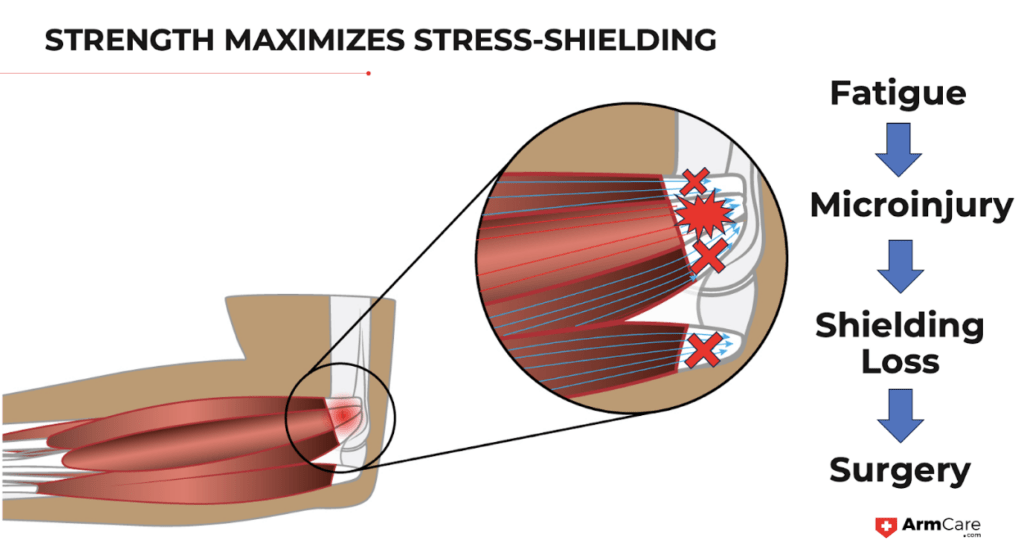
The progression of fatigue indicates how strength loss can mirror tissue weakness and CSA loss.
It should make sense that thicker muscles, tendons, ligaments, and greater strength are proportional to muscle size—think Arnold Schwarzenegger vs. your 12-year-old starting pitcher.
Pitchers have varied strength properties, but if you have strong fibers that can contract and stabilize your joints, you will be fatigue resistant, as the fibers won’t drop out of being able to handle the force applied, adding to your CSA and ability to shield stress.
Conversely, if you are weak due to fatigue, you are exposed to more microdamage as your tissue strength is not handling the load.
You have fiber drop out essentially from microdamage, and the loss of strength means you have lost the ability to handle tension and SHIELD STRESS.
Stress shielding is only possible when you have healthy solid fibers. When they are not strong or weakened, the torque applied to the forearm flexors, ligaments, and tendons increases.
That takes us to a bad, bad, bad place that leads to fatigue-induced injury requiring surgical intervention that costs our system $40,000 per athlete from intervention to rehabilitation.
I love surgeons and their work, but I want everyone to avoid their knives. Here, I’m presenting a preventative solution with way more favorable outcomes.
By testing the throwing arms often, you know when there is a potential stress-shielding loss based on strength and our Strength Velocity Ratio (LBS/MPH) that indicates trouble if your velo is going up and your strength is going down—that means a more forceful delivery on a weakened arm.
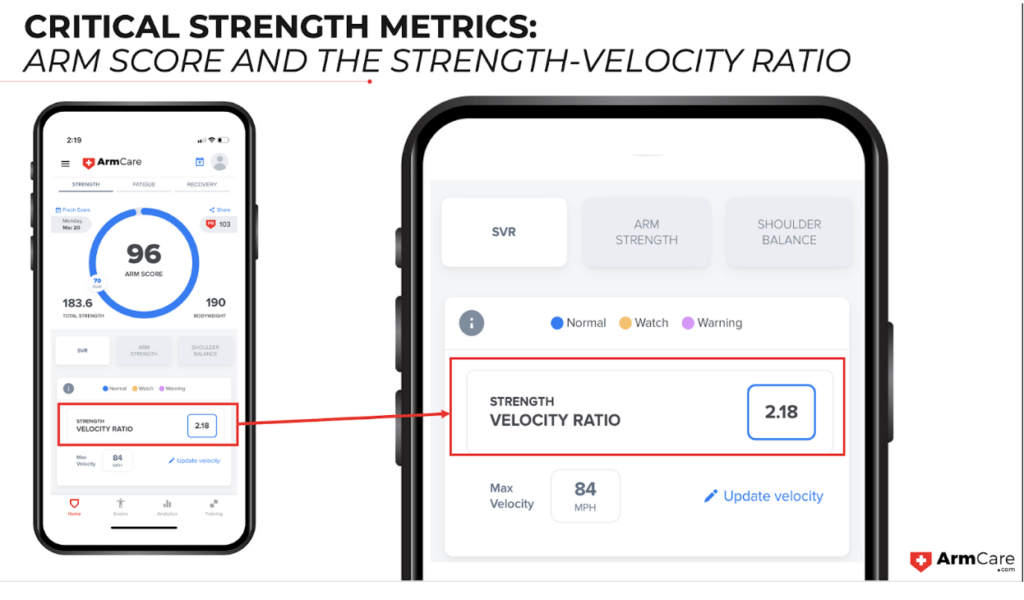
Athletes need to have at least 1.6 on their Strength-Velocity Ratio (SVR) to minimize injury risk, meaning the throwing arm has a heightened ability to handle forces on the muscles, tendons, ligaments, and bones.
Instead of toying with mechanics to “reduce” stress, why not test your athletes now and truly define what a stressful delivery is?
Stay tuned for Part 3 of our debate series and for more on why Strength Matters Most!