Strength in Numbers – 257
Most baseball players spend hours each night on their phones, computers, gaming systems, or streaming content.
The problem isn’t necessarily the technology. It’s what that technology does to your nervous system before bed. Your body operates on a built-in clock called the circadian rhythm.
During the day, the brain promotes alertness by increasing hormones such as cortisol, helping you focus, react quickly, and perform athletically.
As evening approaches, cortisol should naturally decline while melatonin rises, preparing the body for recovery and sleep. Blue light exposure from screens can disrupt that transition.
When bright blue light reaches the eyes late at night, the brain receives a signal that it’s still daytime.
Melatonin production is delayed, sleep quality declines, and the nervous system remains more stimulated when it should be recovering. For baseball players, that’s a bigger deal than most people realize.
Recovery is not simply about muscles.
It’s largely a nervous system process which is responsible for:
- Recruiting muscle fibers
- Producing force and power
- Coordinating movement
- Restoring strength after training and competition
- Managing fatigue during and after intense training and games
When sleep quality suffers, athletes often experience:
- Slower recovery between outings
- Reduced strength production
- Higher fatigue levels after high effort throwing, hitting, and training
- Poorer reaction time and decision-making
- Increased soreness and stiffness
This is why we often see changes in throwing arm function before athletes realize they’re under-recovered.
A pitcher may feel “fine,” yet show lower recovery scores, more post-throwing strength loss and reduced ArmScores.
In many cases, the issue isn’t training harder. It’s recovering better.
Blue-light-blocking glasses can help support the body’s natural transition into nighttime recovery by reducing the wavelengths of light most associated with melatonin suppression.
Combined with limiting screen exposure 60–90 minutes before bed, athletes can improve sleep quality and give their nervous system a better opportunity to recharge.
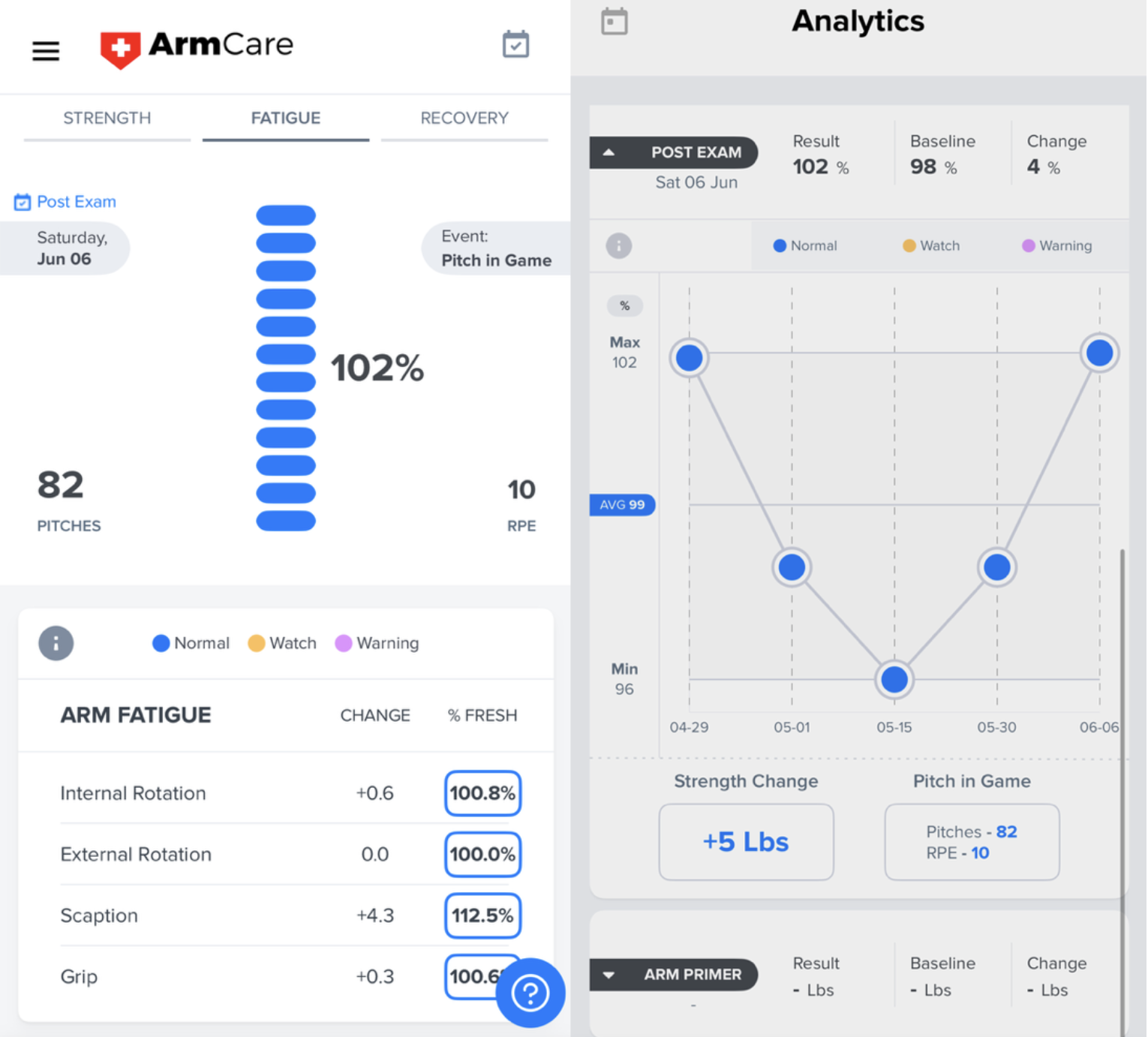
Post-throwing strength exams provide insight into nervous system readiness and recovery. This athlete not only maintained strength after pitching but also improved over time, suggesting enhanced neuromuscular efficiency. Improved sleep, reduced academic stress, and lower overall fatigue likely contributed to this upward positive trend.
Training creates adaptation. Recovery allows adaptation to occur.
The strongest athletes are not always the ones who train the hardest.
They’re often the ones who consistently create the best environment for recovery. If your recovery scores are trending down, your post-exam strength isn’t bouncing back, or fatigue alerts keep appearing, don’t just evaluate your throwing program.
Look at what you’re doing before bed. The next velocity gain, strength increase, or recovery breakthrough might start by turning off a screen or putting on a pair of orange glasses.

Check this video link to learn more.
STRENGTH MATTERS MOST.
Ryan