

Strength in Numbers – 262
For years, Pedro Strop was one of Major League Baseball’s most dominant relievers. Armed with a fastball that routinely touched the upper 90s and an upper body that rivaled a bodybuilder, he carved out a remarkable 13-year career.
Having coached Pedro early in his career with the Baltimore Orioles, I can say with confidence that very few pitchers possessed his combination of arm strength, work ethic, and competitive fire.
Yet like many pitchers, his velocity gradually declined.
The obvious assumption is that his arm simply became weaker with age, but I don’t believe that’s the whole story.
This week’s Strength in Numbers was inspired by a post featuring him and a comment that really resonated with me – the connection between altered strength and mechanics, and that theoretically, if a woman had the same strength and movement qualities, she could achieve results just the same as men.
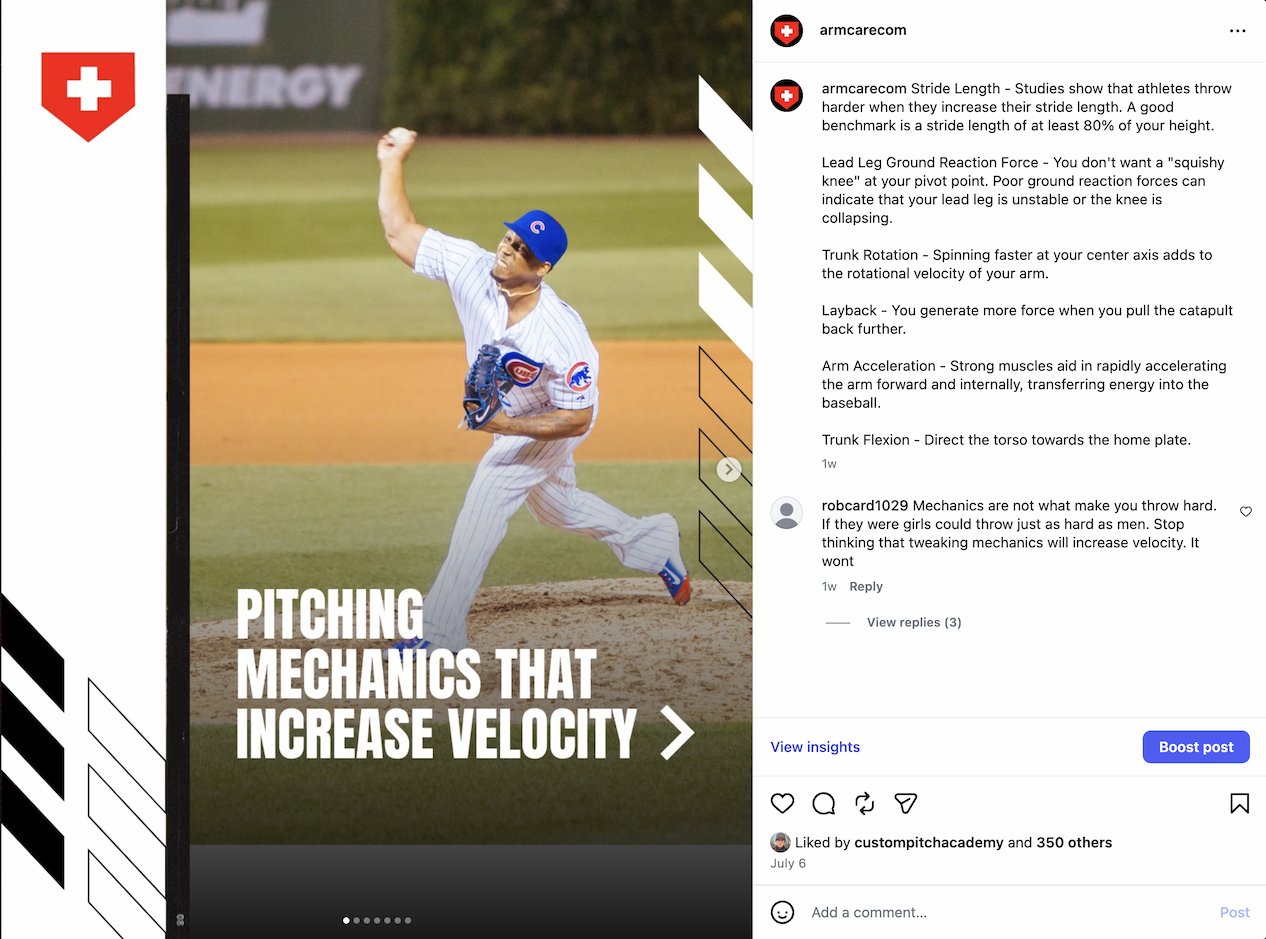
Over my 10 years in MLB, I’ve seen pitchers come in all shapes and sizes.
I have seen the largest, most conditioned athletes throw lighter than 16-year-old players we sign internationally. I have coached the likes of Jamie Moyer and his son.
Jamie pitched almost until he was 50 years old, barely breaking 80 mph, and was a trusted MLB arm.

Blessed to work with both these pitchers. Jamie Moyer on the left and Pedro Strop on the right. Very different body characteristics, very different mechanics, but both were effective until one had an injury that affected his mechanical consistency.
When pitchers lose velocity, most conversations immediately shift toward mechanical adjustments. While mechanics certainly influence performance, people do have to understand that the physical forces behind them—namely, the application of force from the ground and through the body’s linked segments—are at work.
If the body loses the ability to produce force efficiently, the delivery must adapt, and even if your arm is strong, mechanical consistency can erode.
Looking at Pedro’s career, his fastball velocity remained remarkably stable for several seasons before beginning a noticeable decline. At nearly the same point in his career, lower-body injuries—including hamstring strains, a meniscus injury, and groin involvement during rehabilitation—began to accumulate.
Although this timing does not prove one caused the other, it raises an important question that every pitcher should consider:
What happens to velocity when the foundation of the delivery begins to change?
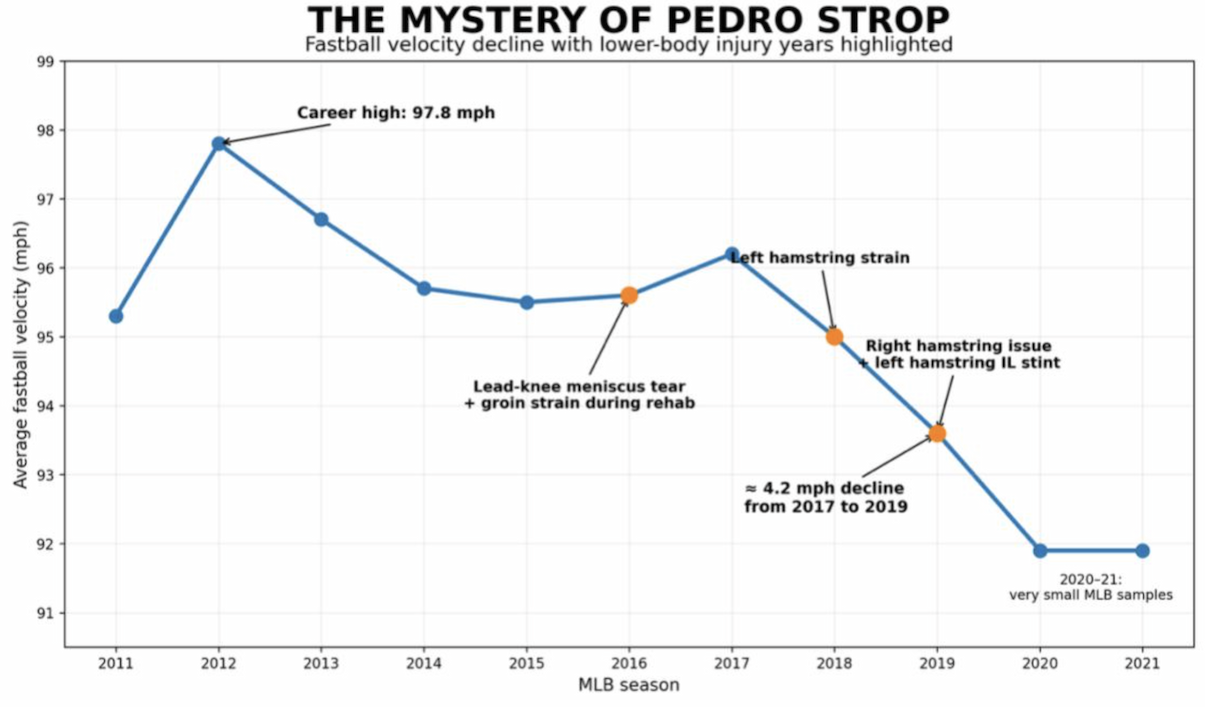
Pedro’s arm did not suddenly become weak. The kinetic chain likely changed. Lower-body injury may have altered ground reaction force production, pelvic rotation, lead-leg stabilization, and energy transfer, requiring greater reliance on the throwing arm to maintain velocity.
The body rarely gives away velocity without trying to compensate…If the lower body generates less force, the trunk often rotates faster to compensate.
The throwing arm may have less time to achieve optimal layback while simultaneously being asked to produce more of the velocity independently.
Initially, the pitcher may still perform well.
Over time, however, greater reliance on the arm can increase muscular demand, delay recovery, and make it progressively more difficult to maintain elite velocity.
In other words, the arm may not have become weaker—the workload placed upon it simply became greater.
What the Data Suggests
Pedro Strop’s average fastball velocity across his career alongside the seasons in which significant lower-body injuries occurred.
Physical changes often precede mechanical changes. Mechanical changes often precede performance changes. Strength changes may not occur in the throwing arm, but they do impact mechanics, so the comment in the Instagram post was not wrong; it just needs more context.
Strength matters most to facilitate mechanical consistency. Yet when strength is optimized, you have to improve how the body coordinates, or else Arnold Schwarzenegger would be a number 1 starter in the MLB during his prime.
Velocity loss is frequently the first measurable clue that something within the kinetic chain has changed long before pain or injury appears.
Rather than asking, “How do I fix my mechanics?” a better question may be…
“What changed physically that caused my mechanics to change?”
Strength Matters Most – but that doesn’t mean that mechanics do not matter.
Ryan