In Rocky IV, Rocky Balboa retreats to the wilderness to grit out his training in an old barn and by carrying logs in the snow. At the same time, his opponent, Ivan Drago, goes to a Space Age training facility with the latest Soviet technology to prepare for the fight.
This juxtaposition perfectly shows the evolving landscape of sports performance.
Should athletes depend on their guts and submit to the grind, like in Rocky’s sweat-soaked training montage, or fine-tune their performance with Drago’s state-of-the-art, machine-driven preparation?
While it makes for great cinema, here at ArmCare, we don’t see it as a crossroads between these two worlds.
The ArmCare app seamlessly integrates into an athlete’s training program to best guide their hard work, but effectively combining the two approaches takes some insight and experience.
This article will combine critical ArmCare App analytics with gut decision-making.
The ArmCare Key Metrics
Understanding the ArmCare app’s key metrics is essential for maximizing its benefits. These metrics are not just raw data. They provide critical insights into an athlete’s readiness and risk factors to help guide training and competition decisions.
1. ArmScore & Strength Velocity Ratio
These screens are assessments that help determine an athlete’s injury risk based on the principle of Force = Mass x Acceleration. The implication is clear: Higher mass, along with elevated throwing arm accelerations, exert more shoulder and elbow force which increases injury risk.
Consequently, optimal strength performance is essential. Ultimately, these metrics are utilized to help tailor training to increase strength and elevate throwing velocity to effectively withstand throwing arm forces.
2. Fatigue & Recovery
Measured post-throwing, the fatigue score reveals how much strength an athlete loses from a single outing across all muscles tested. Similarly, the recovery score measures an athlete’s strength on subsequent days after throwing and evaluates their readiness to throw again. A low recovery score means that an athlete’s arm is still recovering from an outing or training session.
A high fatigue or low recovery score indicates a decreased capacity of the muscles to stabilize the shoulder and elbow, which places greater stress on the ligaments and tendons of the arm. These are crucial metrics for deciding when to stop or dial back to prevent injury.
3. Range of Motion (ROM)
Range of Motion (ROM) is a metric in the ArmCare app that measures the movement capability of an athlete’s shoulder. By monitoring the ROM, the app provides insights into the changes within the athlete’s training to increase mobility but also provides early warning signals when strength and mobility are misaligned. Things like muscle tightness, joint stiffness, or hyperelasticity can be early signs of injury.
4. Shoulder Balance
Shoulder balance compares the strength of the muscles on the front of the shoulder to the back of the shoulder. An imbalance in the strength of these opposing muscle groups can lead to poor shoulder stability and potentially increase the risk of injury.
Decision Making
Knowing when and how to make informed decisions based on the app’s alerts is crucial, especially if you understand its metrics.
Just like a traffic light, you can categorize the app alerts into varying levels of urgency.
1. Red Light: Stop! Do NOT Throw
- Pain
- Medical Alerts
- Fatigue, Recovery, or ROM Warnings
2. Yellow Light: Avoid Competition & Intense Throwing
- Fatigue, Recovery, or Range of Motion Watches
3. Green Light: Competition Ready (but with caution)
- Low ArmScore (below 70) or watch/warning on SVR or Shoulder Balance
The following will go through the breakdown of these categories and the actions that should be taken.
Red Light – DO NOT THROW
There are situations when you need to stop throwing. These are hard decisions because of the desire most athletes have to push through and their fear of disappointing a coach or the team.
However, no team or coach should want players to risk their longevity in the sport to log a win. And while a player might fear falling behind, solving these problems will only progress them forward.
We cannot overstate the importance of giving the arm added time to fix strength performance with additional recovery to prevent the progression of minor issues that can become severe, long-term problems, or surgeries.
• Arm Pain
The principle here is simple: NEVER THROW THROUGH PAIN. Pain is a definitive signal to discontinue throwing until the issue is resolved.
For more information on pain, follow our pain management workflow.
• Medical Alerts
When a medical alert pops up, it’s a red flag that a player might already be injured or have circulation or neural issues, and continuing at the current pace will most likely lead to injury. Immediate action and help from a medical professional with knowledge about throwing and arm injuries is required.
• Key Metric Warnings
Like a car’s check engine light, these alerts are early signs of an underlying arm problem. Warnings for the Recovery, Fatigue, or ROM metrics should prompt players to stop throwing.
Yellow Lights – Avoid Competition & Intense Throwing
These alerts require judgment calls: sometimes, you can manage them with careful monitoring alongside ongoing training and competition, provided the athlete performs without pain.
For yellow light conditions, ideally, players should reduce intensity and throw counts in bullpens, including throwing to hitters and abstain from any velocity enhancement training.
It’s crucial to understand the upside of not competing in these cases. By acknowledging these alerts and reducing competitive stress when they appear, athletes can avoid exacerbating existing injuries or developing new ones.
Together, athletes, coaches, parents, and medical staff must evaluate the risk vs. reward when handling yellow-light situations.
Whether it be an elimination playoff game or an early-season game, both pose a greater risk when competing with an arm that is not functioning well. Travel ball coaches have a serious responsibility and need to formulate action plans for concentrated tournament schedules so that players have a healthy and productive season. The best answer is to skip a start when a “Yellow Light” appears, but sometimes, the potential reward is greater than the risk in coaches’ and athletes’ minds.
Utilize this important information to make an informed decision when managing yellow light cases, such as training experience, level of play, or a history of injury or arm pain.
• Key Metric Watches
Watches for the Recovery, Fatigue, and ROM metrics indicate an impaired arm that needs more recovery and workload adjustments before resuming a full throwing workload. This is also a reason to discontinue a throwing program or velocity enhancement plan and fix strength, fatigue, recovery, and imbalance issues.
Green Light – Throw with Caution
Green light situations are approved for throwing and competition, but always be on the lookout for alerts, just as you should when driving through a busy intersection.
The signs below indicate that a player has a higher risk of injury. That means you have to work on weaknesses concurrently with their regular throwing schedule.
Additionally, despite being cleared for throwing, these signs indicate when a player is NOT ready for a velocity enhancement program. For more information on starting a velocity enhancement program, check out our ThrowFuzz Velocity Enhancement Checklist.
• Low ArmScore
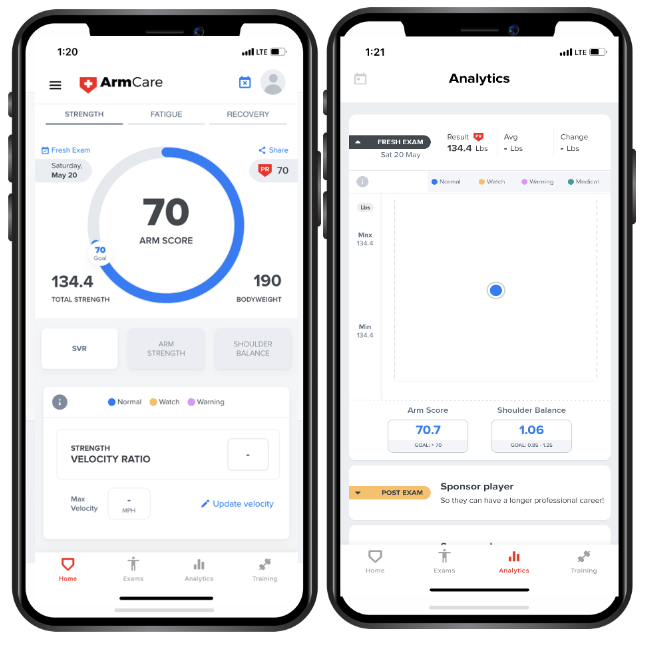
These measures indicate athletes’ throwing arm strength-to-body weight ratio and can indicate potential issues with an athlete’s current level of strength and risk for injury. Alone, they shouldn’t be alarming as long as there are no other alerts or a history of arm injuries. However, when velocity increases, strength improvement should be at the forefront, while increasing velocity should be done in the back seat and buckled up.
• SVR or Shoulder Balance Watch/Warning
These metrics indicate if the throwing arm is advancing with increasing velocity. A weak and imbalanced arm that throws hard is a problem waiting to happen. Gain far more by working on specific weaknesses around the arm than by attempting to push velocity higher.
Conclusion
Integrating the insights from the ArmCare app into a baseball training program offers a modern approach to monitoring and enhancing a player’s throwing performance.
By understanding and responding to the app’s detailed metrics and alerts, coaches and athletes can make smarter, safer decisions that align with both short-term performance and long-term health.
The Player-Led Approach offered by ArmCare.com allows all athletes in the game to inform their coaches where their throwing arms are on the day to make dynamic changes to win championships.
If you are a coach and want to be at the forefront of player development in creating individualized throwing programs, pitch count schedules, and throwing arm training, it’s time to blend old-school grit with modern technology to change the game forever.