Strength in Numbers #221
Fall baseball has become a popular addition to the calendar for amateur and high school players, often stretching competitive activity from mid-March until late October.
While this provides valuable development opportunities, it also poses significant cumulative workload risks that players, parents, and coaches must be aware of. When workloads aren’t managed carefully, athletes face an elevated risk of injury, fatigue, and underperformance.
I have also personally witnessed some crazy things this Fall season that I want to warn you about as you navigate this very sensitive part of the season when athletes are juggling school, high school teams, fall ball teams, and training.
We tend to de-prioritize training at this point in the year. When it is prescribed, it’s often in the wrong place in the week, as it relates to games and mound work, usually sacrificing complete recovery of the throwing arm, which is essential for competition.
Be very aware EVERYWHERE in October.
Cumulative Workload and Overuse Injuries
Most athletes now play 7–8 months straight, often with minimal downtime. Unlike professional players, who may follow individualized workload tracking and have daily maintenance with the training staff to mobilize soft tissue and reduce pain, amateur players are frequently managed with blanket pitch counts and generalized schedules.
These schedules often include hill runs to build team toughness and over-volumized training that puts the Fall season in quasi-offseason training schedules.
The issue is that workload isn’t just the number of innings pitched — it’s the sum of throwing, hitting, weight training, practices, and games. Although coaches believe they are serving players by limiting them to only a few innings per game on the mound, the cumulative effect of every game leading up to this point in the year needs to be considered.
Continuous stress without adequate deloading phases can accelerate the breakdown of the shoulder, elbow, and lower back. Overuse injuries such as Little League elbow, labral tears, and early ulnar collateral ligament (UCL) damage are increasingly common in this extended season format. The other time we see a spike is during pre-season, which often results from undertraining, leading to an acute rise in throwing workloads.
The intersection between elite recovery habits and monitoring the throwing arm closely is essential for this part of the season. Some players are currently engaging in high-intensity weighted ball training and competition during the Fall season. This presents a serious risk, especially if the athlete is participating in competition and simultaneously at the highest level of training.
The Temperature Factor
One often-overlooked risk during Fall Ball is the change in weather. As temperatures drop, so does muscle elasticity and joint fluidity. Cold environments reduce blood flow and delay muscle activation, making tissues more prone to strains and tears.
On a biochemical level, lower body temperatures slow enzymatic reactions and impair the nervous system’s ability to fire muscle fibers efficiently. This increases the risk of:
- Slower reaction times
- Reduced force output
- Microtears in muscle fibers and connective tissue
Athletes pitching or swinging in cold weather without extended warm-ups are especially vulnerable to acute muscle and tendon injuries.
One of the most important things a coach, parent, or player can do at this point in the season is to increase the time allotted for the activation/dynamic warm-up process for players. Rushing to the field, showing up to play without ample time to prepare, or throwing pitchers in a game who have not taken adequate time to prepare can lead to injuries.
We thoroughly cover the Arm Primer in our Certified ArmCare Specialist Course. The Primer may be needed to prepare the athlete’s arm for Fresh Exams when the weather turns. The sequencing of isometric contractions, first through the primer to activate the arm’s muscles from the trunk to the wrist, and then proceeding to our standardized testing, can collectively amplify muscle function for the rotator cuff and dynamic stabilizers of the inner elbow.
The Training-Pitching Conflict
Another growing problem in Fall Ball is the clash between strength training and mound work. Many players double up — lifting weights in the morning and throwing intensely in the evening. This creates two layers of stress on the body with inadequate time for repair. Carryover fatigue effects can also be seen when scheduling a mound day within 36 hours of a lifting session.
From a physiological standpoint, heavy lifting in proximity to games or bullpens induces:
- Microtrauma in muscle fibers
- Inflammatory signaling (chemical biomarker release)
- Increased protein breakdown (catabolism = breaking down protein in the body)
Repair and adaptation for adolescent and high school athletes, especially those with low testosterone, require at least 48–72 hours, depending on load. When athletes pitch before the repair is complete, they interfere with the recovery of the throwing arm. The result: higher fatigue, poor mechanics, and increased likelihood of breakdowns in the shoulder, elbow, and forearm.
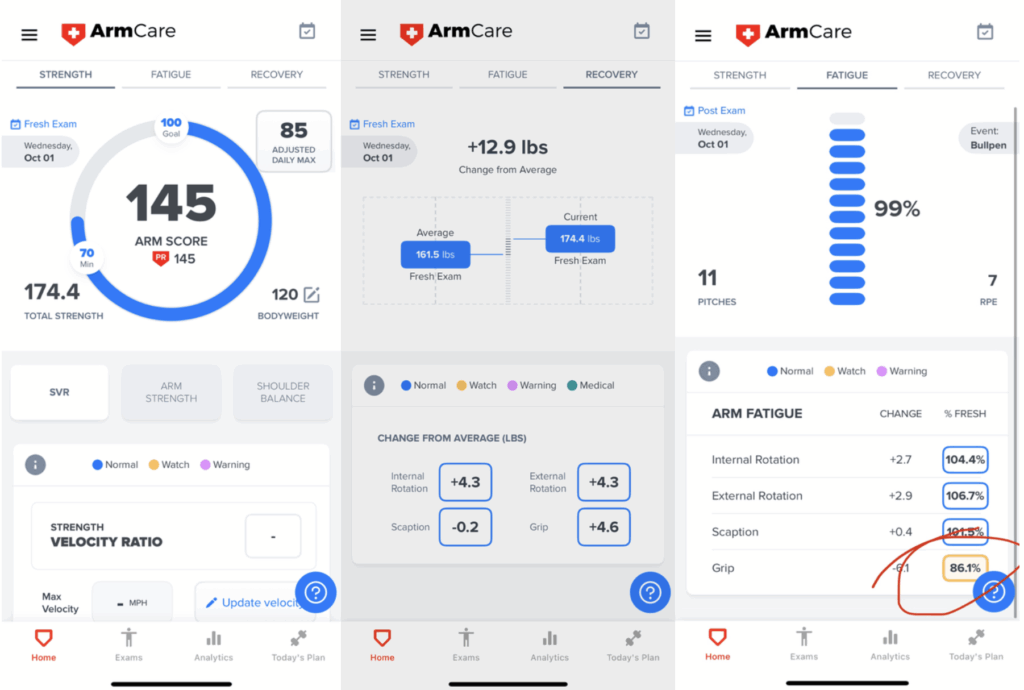
Data from a player who is nearing a return to competition on the mound after a significant forearm flexor strain this summer.
Although this athlete had a significant bump in recovery, hit a new PR, and was highly motivated to throw 30 pitches, he had lifted weights the day before, and my suspicion was correct in that I believed he would have some residual neurological fatigue that would carry over.
Lo and behold, look what happened to his grip strength after lowering his workload to a third despite having such great recovery data. Inadequate recovery and poorly scheduled lifting routines in relation to mound days and games accelerate risks associated with strength loss.
Muscle Breakdown and Recovery in Pitchers
The body follows a predictable cycle after training stress, but varies in recovery depending on muscle mass, hormonal status, and previous injury:
- Muscle Breakdown (0–24 hours): Fibers are damaged and inflammation peaks.
- Repair and Adaptation (24–72 hours): Protein synthesis rises, and new tissue forms.
- Supercompensation (72+ hours): Muscles and connective tissues become stronger if recovery is allowed.
During Fall Ball, when pitchers stack throwing sessions on top of lifting stress without adequate recovery, they miss the supercompensation phase, instead compounding the breakdown that began at the start of the season. Over time, this leads to chronic fatigue, strength deficits, and eventual injury in later stages of the season.
Perturbation training at the end of training sessions, after mound work or games, can increase blood flow and reperfusion (pouring in new blood) to help heal the arm. We need circulation to the throwing muscles to repair damaged tissues and to help muscle fibers regrow.
We explore many aspects like this in our Eliminating Pain and Soreness Course, and we actually have dedicated sections to show you how to do perturbation training in our Certified ArmCare Specialist Course. Learn and master this critical technique.
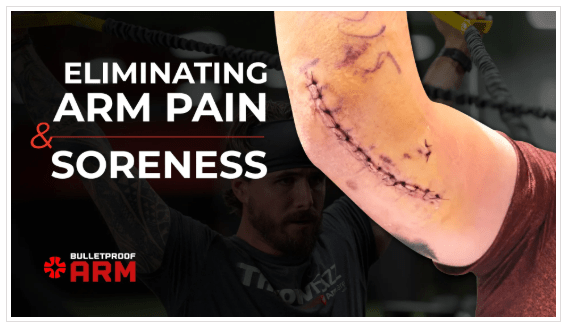
With our new ArmCareU subscription that covers access to all our Bulletproof Arm Courses and more, you can unlock the power of understanding how to stop pain and soreness, pitching development, velocity enhancement, critical steps to recover the arm, building data-led throwing programs, and access to classes that blend science and application.
Key Takeaway
Fall Ball provides valuable reps, but it must be approached with caution. Workload must be managed holistically, accounting not only for innings or pitches but also for factors such as temperature, training stress, and recovery windows. Athletes who fail to balance these elements risk carrying fatigue into the following spring, jeopardizing both health and performance.
To thrive in Fall Ball and beyond, coaches and players should prioritize:
- Attacking Pain, Soreness, and Recovery Approaches
- Longer warm-ups in cold weather to improve muscle activation
- Monitoring recovery windows before and after lifting to avoid overtraining
- Individualize training and throwing workloads with ArmCare data
- Have an ABC action plan where the athlete knows what is expected at high, moderate, and low levels, as it relates to strength, recovery, fatiguability, and shoulder balance.
Durability is built not just by throwing more, but optimizing highs and lows with data.
Don’t fly blind – Strength Matters Most.
RyanRyan@armcare.com