

Strength in Numbers #182
For over 75 years, the American Baseball Coaches Association (ABCA) Convention has served as the beating heart of baseball innovation, education, and making new friends in the game. It is a hallmark event that gathers coaches, educators, players, and innovators under one roof to advance the game we all love, and the stories are endless.
I just returned to my hotel room after a long day of meetings and our presentation on something we all hate – pitch counts, the restriction of competition, and what I mean by less equals more – less pitches thrown, more injuries seen.
Ironic, right?
Well, undertraining the throwing arm is no joke. I think it is worse for the arm than throwing too much, as overuse injuries are a capacity flaw. If we train our pitchers to hand over the ball at pitch 100 and see them as porcelain, I promise they will surely break.
During our Tech Expo talk, “Pitch Counts Suck – Here’s the Future,” I asked a show of hands who had heard of ArmCare.com.
In my first year, I asked the same question, and four people raised their hands, two of whom I knew personally. With the help of the legendary Tom House and Dean Doxakis of the National Pitching Association, we brought in many people who sat in front of the stage and stood around the peripheral border of the Tech Expo.
There were about 200 people on hand, maybe more.
I asked the audience to show their hands if they had heard of ArmCare.com. To my amazement, nearly every person whose face I could see put their hand up. The message is powerful because it is catching fire to put out flames and flare-ups.
Throw Harder. Throw Smarter. Throw Stronger. Throw Longer.
ThrowFuzz has caught fire, and we are now realizing that we can throw smoke without getting burned.
THE AFTERMATH OF PITCH COUNTS SUCK
I will discuss the presentation’s finer points in the article, but I want to start with the discussion following the Tech Expo event.
Generally, after a strong presentation, people hang around to ask questions about the points you raised. Some are extremely contrary to the messages, others want clarity, and a third of people flat-out take your message and want to run with it.
After the presentation, I easily met with 50 people, and then I moved toward the coffee shop and other areas of the venue to discuss some issues in depth.
These were not only just people interested in our new ArmCare Accelerator course— the full package that comes with either in-person or remote education, technology, training equipment, and immense actionable insights—but people who are ArmCare students.
To date, we have over 1000 students across our education offerings, and we are dedicated to helping them.
With that in mind, I sat for 5 hours absorbing new information from people and offering best practices from my experience and viewpoints.
It is also interesting to meet people who have taken our courses, people I have never seen or met before, and who praise our information and impact.

KEY QUESTIONS AND ANSWERS
I will paraphrase and highlight two of my favorite conversations. They come from existing coaches using our system and have questions they want answered.
The best part is that the answer requires collaboration and buy-in from all team members, with a concentrated effort on key stakeholders to keep athletes’ arms healthy. Our in-person and remote education is designed to get everyone on the same page, and it started sinking in. We can help mediate tough conversations crucial for the teams’ performance and injury protection.
Q1: Why are the Shoulder Balance Ratios so Resistant to Change
- A prominent D1 pitching coach communicates his frustration that some players’ shoulder balance scores are not shifting. The coach and the medical staff have been working tirelessly on their strength programming, manual therapy, and modalities and are not seeing change – I mentioned three possible solutions
A1: Collaboration and a Specialist Generalist Approach is Essential
- Sit with the strength staff and evaluate each player on our dashboard. The visual we have for shoulder balance in the PDF is very clear. We don’t want to see a lot of space between the lines, and the color between lines indicates the imbalance, whether it’s external or internal. See below.

- I recommend the strength coach eliminate or significantly deload (reduce in sets and intensity) pressing and vertical pulling. Although the strength program is balanced between anterior (front side of the body) and posterior (back side of the body) upper body exercises, it is activating the internal rotators (pecs and lats) way too high. It needs to be unbalanced in the opposite direction (more posterior training).
- On the training side, pressing should be replaced with pec fly work, which engages the pec in a more sport-specific way and will not over-activate the pec, as you can press way more weight than you can in performing a fly.
Q2: Should our Athletes do a Fresh Exam the day after High Intensity Throwing?
- Another data-minded D1 pitching coach asks if doing a Fresh Exam the day after highest-intensity throwing is a good idea. I was curious if you could do too many exams and if the primer alone would be a good solution in between.
A2: Research and Development is the Key to Arriving at the Right Process
- During the early stages of throwing programs, when we are going three times per week, I evaluate the throwing arm on Wednesdays and Saturdays, which would be days after high-intensity throwing days with the introduction of mound work and velocity enhancement training.
- I like the Primer daily because it prepares the athlete for the exams. However, to really understand an athlete’s habits, you should evaluate how well the arm bounces back within 24 hours. Athletes need to refine their post-game or post-high-intensity recovery process. You will know you have a good one when your athletes show positive recovery scores within 24 hours.

The Rise of ArmCare.com: From Unknown to Essential

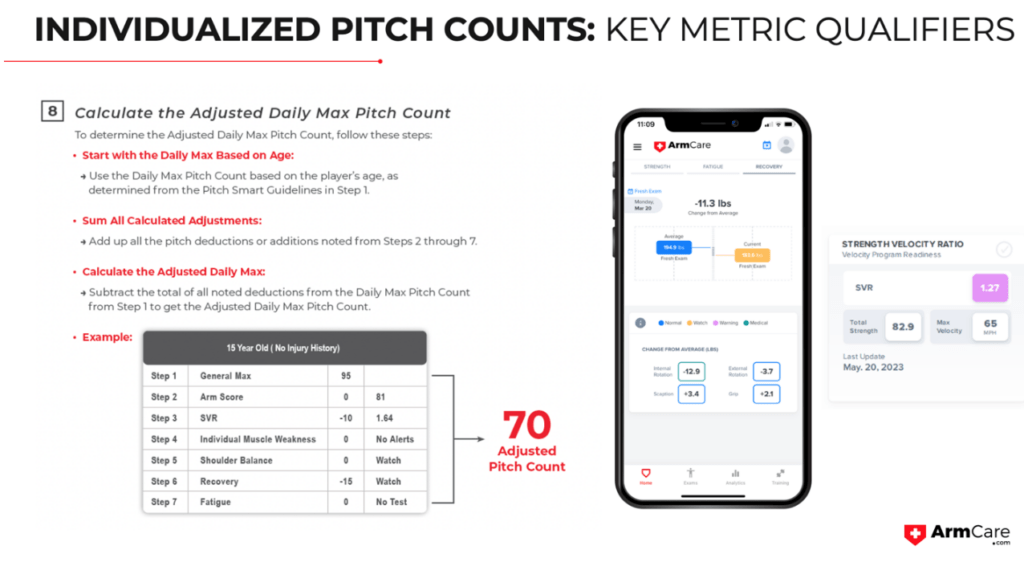
Our individualized pitch count manual can be downloaded here.
When ArmCare.com debuted at the Tech Expo at the 2021 ABCA Convention, it was a relatively unknown player in the baseball technology space.
Fast forward to today, and the company has become a trusted partner of industry leaders like Tread Athletics, Top Velocity, Driveline, and the National Pitching Association (NPA), the latter originated by the legendary Tom House.
Tom is a renowned figure in holistic pitching performance and has become one of the strongest advocates for ArmCare.com’s technology and philosophy. Many of the NPA coaches have become Certified ArmCare Specialists.
At this year’s Tech Expo Presentation, ArmCare.com tackled the provocative topic of “Pitch Counts Suck.” This aligns with the company’s core mission: developing pitching capacity while reducing injuries.
Throwing less gets you injured more, just as throwing more leads to overtraining.
ArmCare.com challenges outdated notions of workload management by providing actionable data that ensures pitchers avoid both undertraining and overtraining.
Tom House spoke about key ingredients in putting pounds of force back into the arm to throw more in following games, while Dean Doxakis from the NPA communicated how the organization scales their throwing and training bouts based on ArmCare.com data.

Workload Management and the Inverted-U Relationship
Central to ArmCare.com’s philosophy is the inverted-U relationship between training stress and performance.
This concept posits that both insufficient and excessive training can lead to suboptimal performance, with an “optimal zone” in the middle where players maximize their potential while minimizing injury risk.
The conventional reliance on pitch counts oversimplifies workload management and fails to account for an athlete’s true capacity.
The optimum comes from paying attention to how arm strength changes and adapting to objective information on strength, recovery, fatigue, and muscular imbalance rather than age, days’ rest, and arbitrary pitch counts assigned to an entire group of pitchers within an age range.
As coaches, we have to manipulate the type of training stress, time, intensity, repetition, and variety. The ArmCare.com platform gives you the “GAS,” “IDLE,” and “BRAKES” signals so that the athlete is trained optimally—not too much and not too little, which have equally negative consequences.

Research shows that a low acute-to-chronic workload ratio (ACWR)—a measure of how quickly training loads change compared to recent historical averages—significantly increases injury risk.
ArmCare.com addresses this issue by equipping athletes and coaches with real-time portable technology to monitor workloads, promoting arm health and durability. You must test after your workloads with our post exams to truly determine how stressful your outings, or throwing sessions were on your throwing arm.
Don’t stress, don’t guess, just test.
Adapting to Modern Baseball Needs
The challenges of modern baseball demand innovative solutions. Low capacity, improper training progressions, and repetitive stress often cause injuries like ulnar collateral ligament (UCL) tears and chronic shoulder fatigue.
ArmCare.com’s tools provide essential insights into arm strength, fatigue, and readiness, enabling individualized workload adjustments to meet each athlete’s needs.
By balancing acute and chronic training loads, athletes can safely adapt to the demands of the game. It could not have come at a better time, but I started my first post on Linkedin in 2025 with this study below:

The Future of Baseball Technology
The ABCA Convention’s impact on baseball transcends generations. It’s not just a gathering but a movement to enhance the sport at every level.
As companies like ours continue to integrate cutting-edge technology with education and training, the future of baseball looks brighter than ever.
The marriage of in-person learning, such as what the ABCA Convention provides, with emerging digital technologies ensures that players and coaches can optimize performance while minimizing risks.
Our product allows you to test theories, other products, concepts, and more. It’s a portable lab, which is what we first called it.
However, it really is the tool of the modern century in baseball. Players are now in control of understanding what is going on with their arm, what it needs, and when they need more gas, breaks, or just to keep it in neutral.
I fear that we may never see a complete game shutout by a starter again.
We are headed to a world where the only perfect game that could be seen in our very near future is one delivered by Perfect Game, the leader in showcase tournaments who is now onboard with ArmCare.com and we are on a mission to make showcase tournaments safer than ever before.
There are only two equations in my mind that will shape the future of baseball.
Equation 1: Throw Less = Injure More
Equation 2: Strength Test More = Injure Less
If you are on the fence, please listen to the sound bite from UCONN Coach Josh McDonald – he gives us living proof that we can exist in a world where you can throw more than ever with less risk of injury.
Strength Matters Most.
Ryan