Strength in Numbers #224
About this time in the competitive season, I start to gulp.
Players finish a Fall season, they get itchy, and they want to immediately get off the mound and start throwing into a net with a high-powered run-and-gun. They do not give their arms a break; instead, they are ready to start velocity enhancement training and are pressed for time because many programs are 7+ weeks long, so they ramp up incredibly fast.
My mind is more slow and steady wins the race, and there’s so much opportunity to gain velocity without weighted balls.
It cannot be ignored that velocity is a critical piece in our modern-day game and social media society. No one talks about statistics for the season.
Hey man, how was so and so’s WHIP or FIP this season? They want to know if the kid hit triple digits as an 18-year-old. And really, the brass only cares if he hits it once. It doesn’t matter if he has sustainable gasoline.
But, pitching and throwing have some major differences.
Blazing velocity that has nothing else to offer, or better yet, is completely erratic, may get you signed, but that doesn’t mean you will make it in the game.
Often, I see how power arms fizzle out in Minor League Baseball, either due to injury (most of the time), an inability to get hitters to swing at bat pitches, or a fastball that is over the top and nothing else to support it, getting smashed at higher levels.
Hitters are getting better all the time. That’s why I laugh when they cannot hit a position player who goes in the 15th inning, throws beach balls, and has a 1-2-3 inning.
The batter’s eye is conditioned for high-powered arms in modern baseball—but a pitcher chasing it blindly can cost shoulders, elbows, and seasons.
I have been working with Dr. Anthony Pizone to conduct a deep dive into this area – we are researching ways to add more fuel with less fire, as arms are blowing up at a record rate.
A Short History of Weighted Balls in Velocity Enhancement
The weighted ball training you see today has been built on years of experimentation. Yet, different methodologies, testing perspectives, cohorts of athletes involved, injury presence, and other factors make the effectiveness of high-intensity weighted ball training for longitudinal performance less clear.
Simply put, some players get better, some stay the same, some get worse, and some go under the knife—and we have a better way to make weighted-ball training safer and more effective for all.
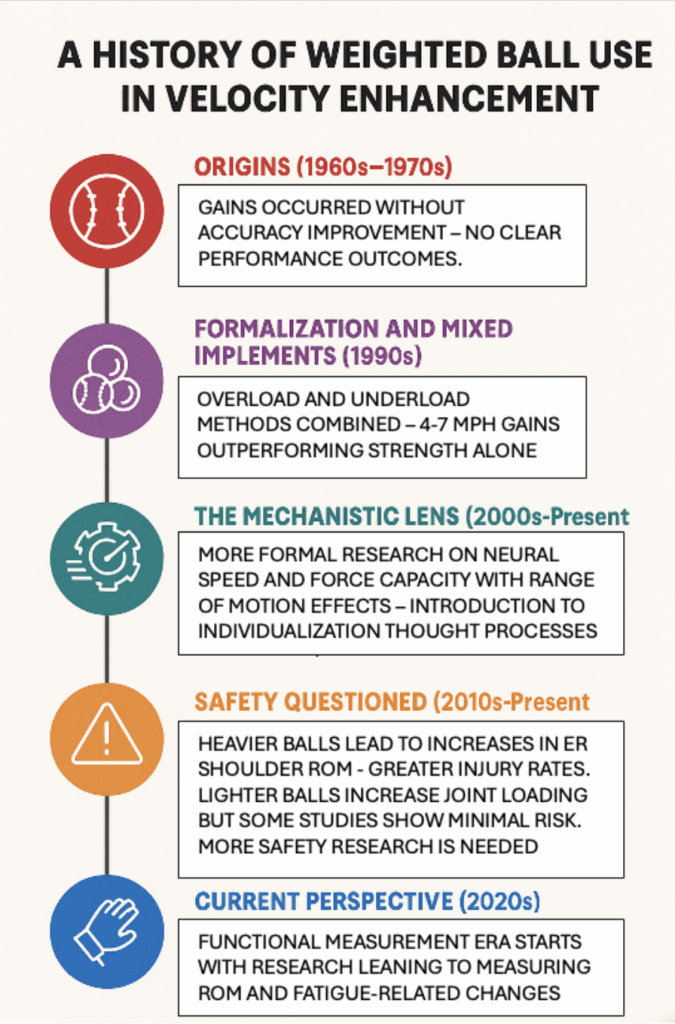
Origins (1960s–1970s)
- Early experiments by Brose & Hanson (1967) and Litwhiler & Hamm (1973) used 7–12 oz balls to boost velocity.
- Gains in throwing speed occurred without improvements in accuracy, suggesting trade-offs.
- Set the foundation that load, dosage, and context strongly influence training outcomes.
Formalization and Mixed Implements (1990s)
- DeRenne et al. formalized combined overload (5–6 oz) and underload (4–6 oz) methods.
- Ten-week programs yielded velocity gains of +4–7 mph, outperforming strength training alone.
- Reinforced the concept that throwing-specific resistance best develops arm power.
The Mechanistic Lens (2000s)
- Research explored why weighted balls worked—linking underload to neural speed and overload to force capacity, thereby leading to greater throwing-arm power.
- Highlighted the role of shoulder ROM and individualized programming.
- Reviews stressed that ball weight, volume, and athlete maturity are critical success factors.
Safety Questioned (2010s–Present)
- Studies by Reinold et al. (2018, 2020) tied heavier balls (6–32 oz) to ER increases and higher injury rates.
- Lighter balls (3–5 oz) improved velocity with minimal mechanical disruption (O’Connell et al., 2022).
- Chalmers et al. (2020) showed that underweight-only training increased speed by 4.8 mph with no reported injuries.
Current Perspective is Specificity and Safeguarding Players
Weighted balls work—but not all athletes see success. Injury risk depends on load, preparation, training age, coaching capability, and monitoring.
The bottom line is that weighted-ball training has a long, evidence-based history of improving velocity. Still, its safest and most effective forms are those that respect mechanics, maturation, and monitoring—test the throwing arm often, and follow our Velocity Checklist to train smarter while you throw harder.
Why Velocity Matters and How to Minimize Risks
Higher pitch speeds reduce contact and raise strikeout probability. Yet the same elevated arm speed increases tensile loading at the shoulder and elbow, elevating UCL and labral risk if strength is not optimized.
The central question isn’t whether we can add velocity—it’s how to do it while preserving mechanics and tissue integrity, and reducing joint loading.
Velocity enhancement must increase arm power (force × velocity) without amplifying joint stress during biomechanically vulnerable phases of throwing, which often include the layback until the instant of ball release—the highest forces in the delivery.
In truth, I do not fear weighted balls; I do not believe they are the devil or demonize them, but when they are programmed, we do so with stringent monitoring, effective coaching, pivot in the training plan when we see a change in key ArmCare data, and every athlete first has to meet the Velocity Checklist criteria.

The ArmCare Velocity Checklist establishes objective, holistic criteria for determining whether a throwing athlete is physically and functionally ready to begin high-intensity velocity-enhancement training safely—particularly weighted-ball programs.
Outside of being at least 17 years old, here are some introductory overviews for the Velocity Checklist:
1. Physical Strength Factors
Athletes must first demonstrate baseline strength and mobility:
- Lower body: Functional lunge competency and single-leg stability.
- Upper body: Minimum strength thresholds in dumbbell presses and pull-ups.
- Core stability: Sustained planks and rotational control.
These benchmarks indicate that the kinetic chain can tolerate and transfer high-force movements.
2. Power & Explosiveness
Readiness includes explosive metrics such as vertical jump height, sprint times, and med-ball throw distance, confirming the athlete’s neuromuscular readiness for high-speed movement.
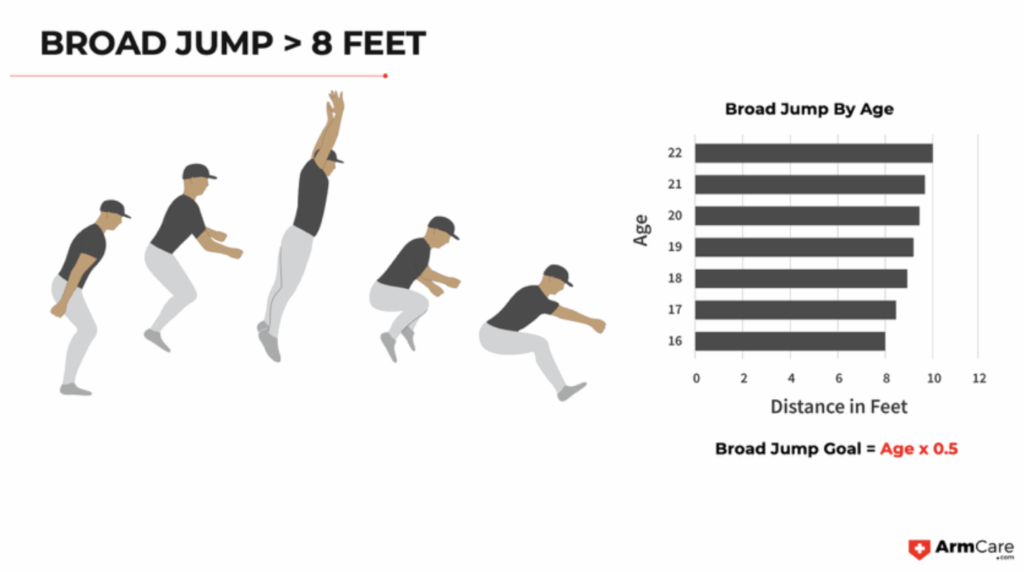
In our Velocity Program Monitoring & Adjustments Course, we go into great detail on the benchmarks needed for success in a velocity enhancement program. If we lack elasticity, we need to work on that first to handle the high-speed bracing and the high-powered lower body, reducing the work on the arm to create moment and energy transfer in the delivery.
3. ArmCare Strength Metrics
Data from the ArmCare.com platform is central:
- ArmScore: A composite of arm strength measures – score greater than 100
- Strength-to-velocity ratio: Ensures the arm can generate sufficient force relative to throwing speed – score greater than 2.0 LBS/MPH
- Shoulder balance: Evaluates symmetry between internal and external rotation forces – maintains an ERIR ratio of 0.85-1.05
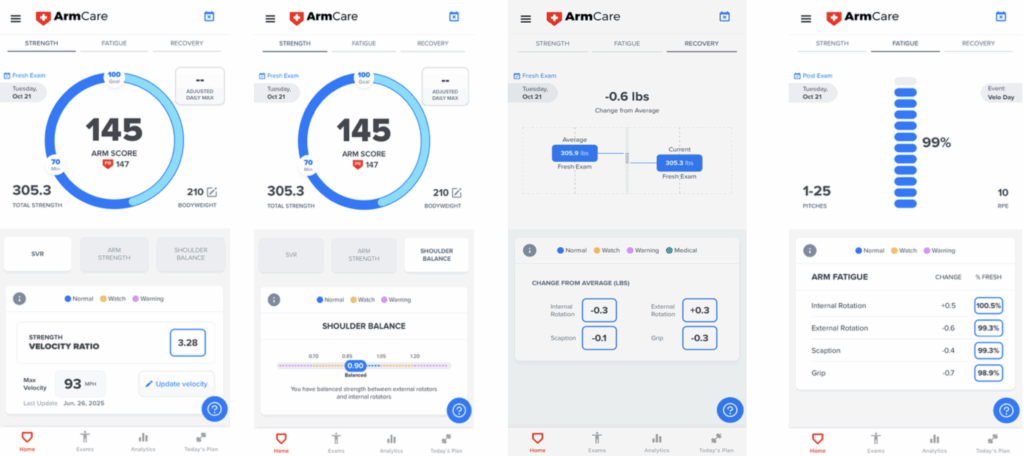
From left to right, you can see that this athlete, who is surgery-free, happens to be over 18 years old, has over 3x force than his velocity capacity, his throwing arm is balanced, recovers well, and doesn’t fatigue – this is an arm that needs consistent monitoring throughout velocity enhancement training, but has no restriction in weighted ball use.
ALL BLUE IN THE APP IS A KEY FACTOR FOR INCLUSION AND PROGRESSION.
4. Recovery & Fatigue Management
Readiness is not just strength—athletes must show arm recovery efficiency, minimal fatigue indicators, and proper rest scheduling. In the above example, the player checks out when you see all BLUE EVERYWHERE.
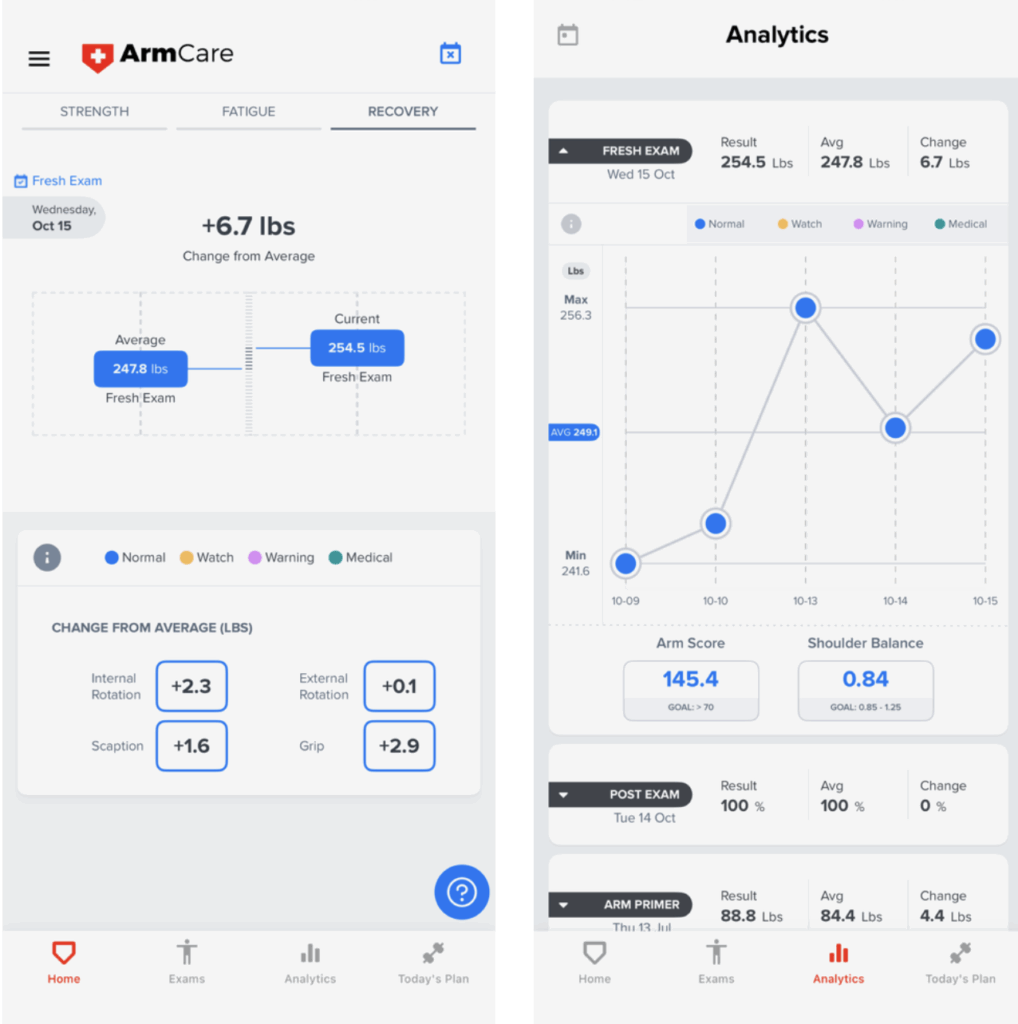
Follow the recoverability of your athletes’ throwing arms. You can do this by hitting the recovery button and the analytics buttons to see a snapshot over a series of days. It is important to discuss recovery strategies with your players so that arm strength can continue to bounce back and be ready for high-intensity velocity-enhancement training.
5. Lifestyle & Habits
Sleep quality, hydration, and nutrition all influence tissue resilience and recovery—these must be consistent before starting high-intensity workloads.
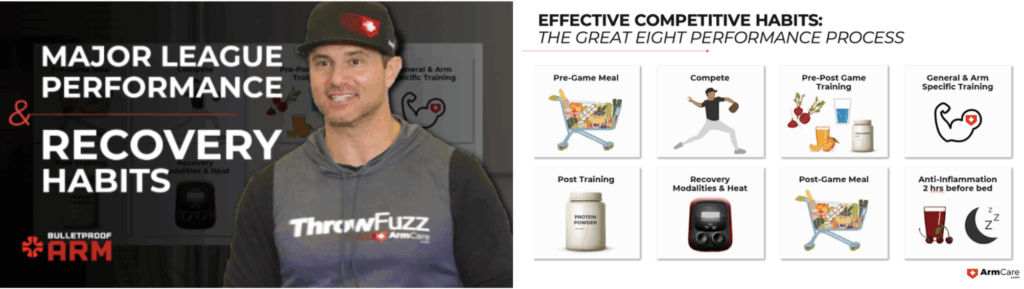
We hammer out a multifaceted approach to this in our MLB Recovery Habits course, going over the Great Eight Performance Process—from overview to minute details—covering everything necessary off the field to be your best on the field.
6. Program Timing
The checklist advises integrating velocity training only:
- During the offseason or ramp-up phases.
- After recovery baselines are met.
- With periodic re-testing for ongoing readiness verification.
Preparation for entry into a velocity enhancement program requires a throwing foundation that exposes the athlete to a series of weeks of throwing while providing high-intensity exposure with the 5-oz ball.
Take-Home Messages
If you are considering using weighted balls, consistently evaluate the throwing arm to assess changes in throwing arm strength, balance, recovery, and fatigue levels after throwing bouts, and always have a download-and-de-load plan.
Skeletally mature athletes who meet the Velocity Checklist criteria must also be mentally and emotionally ready, as this type of training carries significant risks alongside the rewards.
My opinion always is STRENGTH MATTERS MOST – don’t jump in until your arm objectively says so.
Have a great Sunday!
Ryan
Ryan@armcare.com