Strength in Numbers – 269
Fatigue is often treated as something we can see. The other challenge is that 100% of everyone in the sport believes fatigue is something you feel, and that is not the case.
Velocity drops, command disappears, mechanics deteriorate, and the athlete looks tired, but those may be the late signs of fatigue—not the beginning of it.
One challenge in baseball is that an athlete can keep throwing hard while their physical capacity to support that velocity declines.
That creates an important distinction for players, parents, and coaches.
Performance and readiness are not the same thing, as athletes become better compensators as they become more skilled.
Competition Creates a Different Athlete
A bullpen and a game may contain the same basic action—throwing a baseball—but they are not the same physiological experience.
Put a hitter in the box. Add an umpire, runners, a radar gun, and consequences to every pitch. Suddenly the athlete must process information, control emotion, make decisions, execute a pitch, and physically produce it within seconds.
This gives us an important training principle…
Workload isn’t just what you did; it’s the environment in which you did it.
Ten high-leverage pitches with runners on base may create a different stress than ten fastballs thrown during a controlled bullpen.
That is why competition itself is such a powerful training stimulus
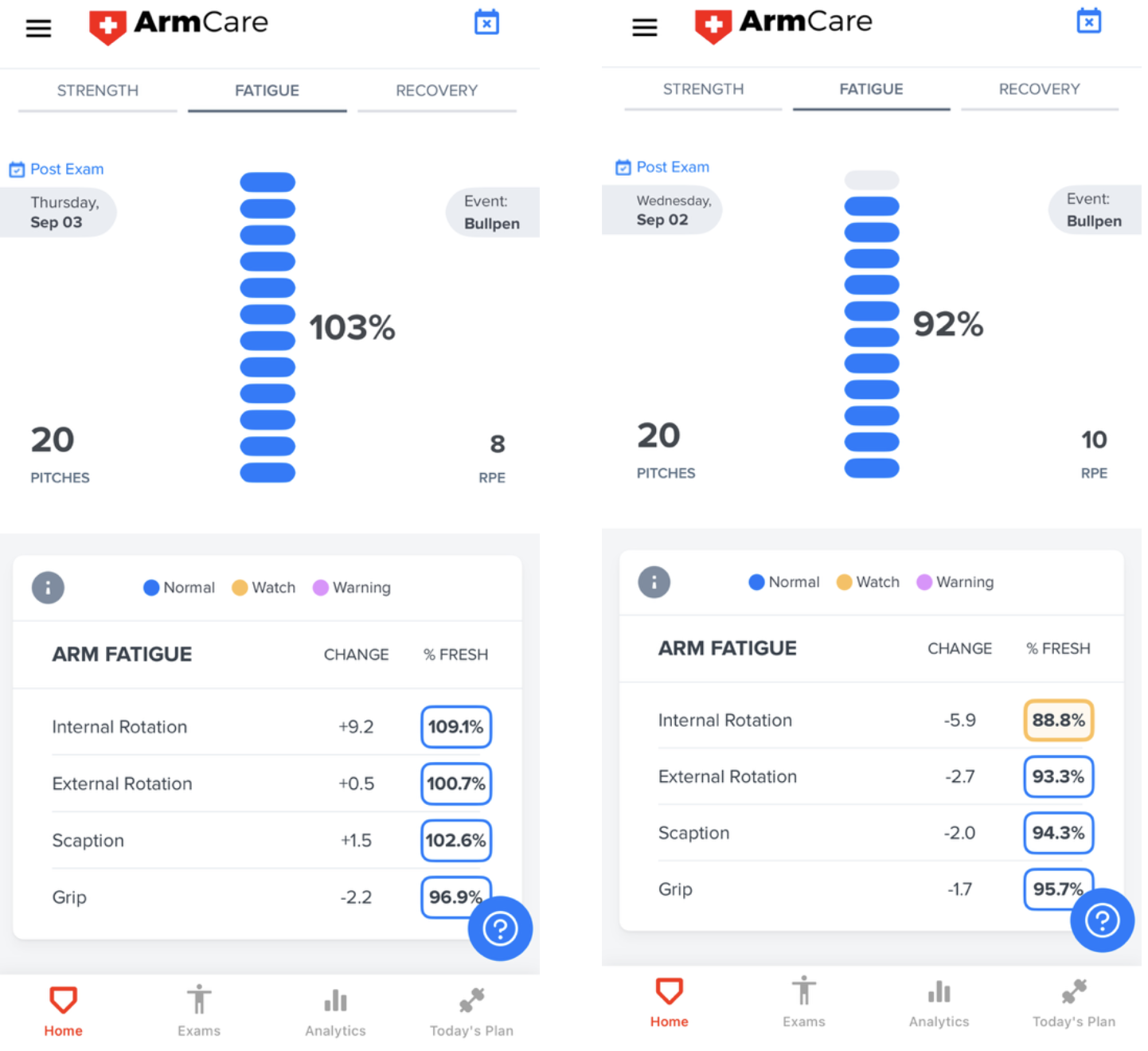
Two different athletes, same pitch total, very different neurological response. On the left, the athlete clearly sustained a submax effort with greater activation than the Fresh exam.
The player on the right, although with greater perceived effort, has way more fatigue in the internal rotators of the throwing arm. Do not believe in bullpen pitch counts to understand the actual physical response of the player.
Compensation Can Hide Fatigue
This may be one of the most overlooked concepts in player development.
Athletes are remarkably good at solving movement problems.
When one part of the system becomes less capable, another part may contribute more. That adaptability helps athletes compete, but it can also make fatigue hard to recognize.
This is why velocity alone is a poor fatigue monitor.
A pitcher doesn’t necessarily need to lose three miles per hour before something meaningful has changed.
In this video, we go through the Fatigue-Induced Injury Model and key compensations you need to understand that lead to stress on the shoulder and elbow.
Takeaway Message
Strength, movement, perceived effort, command, and recovery can begin changing while velocity remains relatively stable.
Instead of asking only:
“Did his velocity drop?”
We should also be asking:
“What did it cost him to maintain it?”
That is ultimately what fatigue monitoring should help us understand—and why measuring the throwing arm can add information that pitch counts and radar guns alone cannot provide.
Strength Matters Most.
Ryan
Ryan@armcare.com