

Strength in Numbers – 270
One question I get from time to time is how did we come up with our strength alerts?
First, strength is not a fixed number. Humans live in organized chaos as it relates to functional measurements.
Test a throwing arm repeatedly and the result will naturally move. Sleep, previous training, throwing workload, motivation, soreness, and even how aggressively an athlete performs the test can create small fluctuations.
That means not every decrease in strength should trigger concern.
The challenge is determining when normal variation becomes a meaningful signal.
In my previous work monitoring throwing-arm strength, about 5 pounds marked the boundary where a change moved beyond the normal day-to-day variation we commonly observed.
That became an important concept: don’t react to every change—identify when the change becomes unusual for the athlete.
Z-Scores – How Unusual Is the Change?
A z-score provides a way of answering a relatively simple question:
How far is today’s result from what we normally expect?
Instead of looking only at whether strength went up or down, the z-score expresses that change relative to the athlete’s normal variation.
A result close to the athlete’s average isn’t particularly unusual. As the result moves farther away from their normal range, the signal becomes increasingly important, especially in a negative direction.
Since 2008, I have been testing throwing arm strength. Once strength loss moved beyond the z-score corresponding to approximately 5 pounds, the odds of an athlete reporting inflammation increased. As losses approached approximately 8 pounds, the signal became increasingly concerning and could lead to time loss rather than conservative injury treatment.
At the extreme end, a change approaching three standard deviations from normal—roughly 12 pounds of strength loss in our monitoring framework—deserves a very different response.
That doesn’t diagnose an injury.
It tells us the result is unusual enough that we should stop treating it as ordinary fatigue and investigate why it occurred.
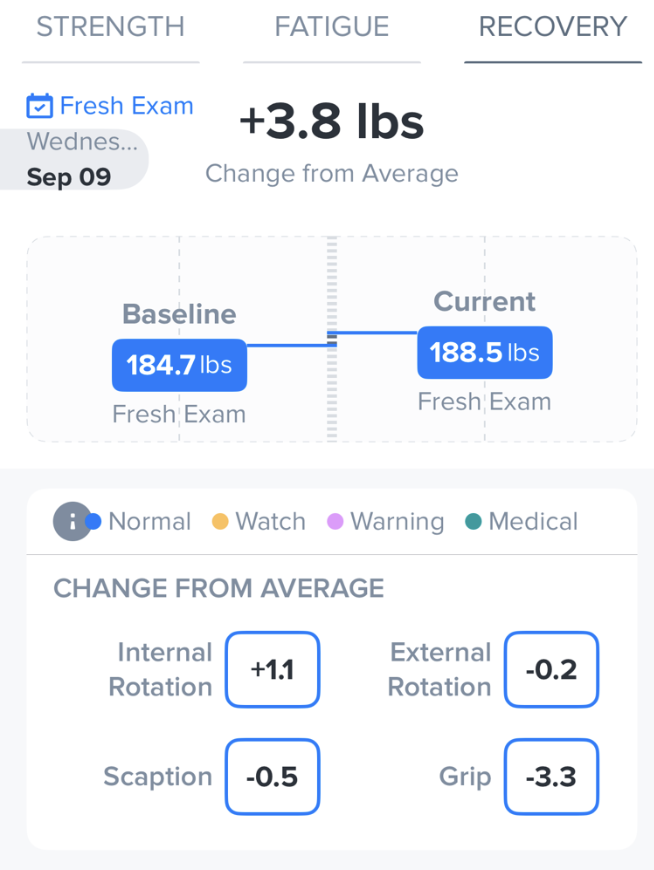
The recovery button indicates how much strength has changed from the average of the top four strength tests for a particular muscle in a 90-day window. This catches strength trickling, where small reductions in strength add up over time.
Smallest Worthwhile Change: When Should We Actually Do Something?
Statistics are useful only when they change decisions.
This is where the concept of the smallest worthwhile change becomes valuable.
If normal strength fluctuates a few pounds, adjusting an athlete’s program every time the number moves creates noise rather than individualization.
For us, approximately 5 pounds became the first actionable threshold.
Not because five pounds means someone is injured, but because it represents enough change to warrant recalibrating what we ask from the throwing arm. From the z-scores, rounding to whole numbers provides a strong signal-detection approach.
5 lb loss → WATCH
The signal has moved beyond the variation we want to ignore. Review workload, recovery, and upcoming training.
8 lb loss → WARNING
The strength change is becoming substantial. Reduce assumptions and investigate soreness, fatigue, recent throwing, and the athlete’s recovery response.
12 lb loss → MEDICAL
This is an unusually large loss of strength. It does not mean the athlete is injured, but it warrants further investigation before simply continuing as planned.
The important distinction is that these are decision thresholds—not injury thresholds.
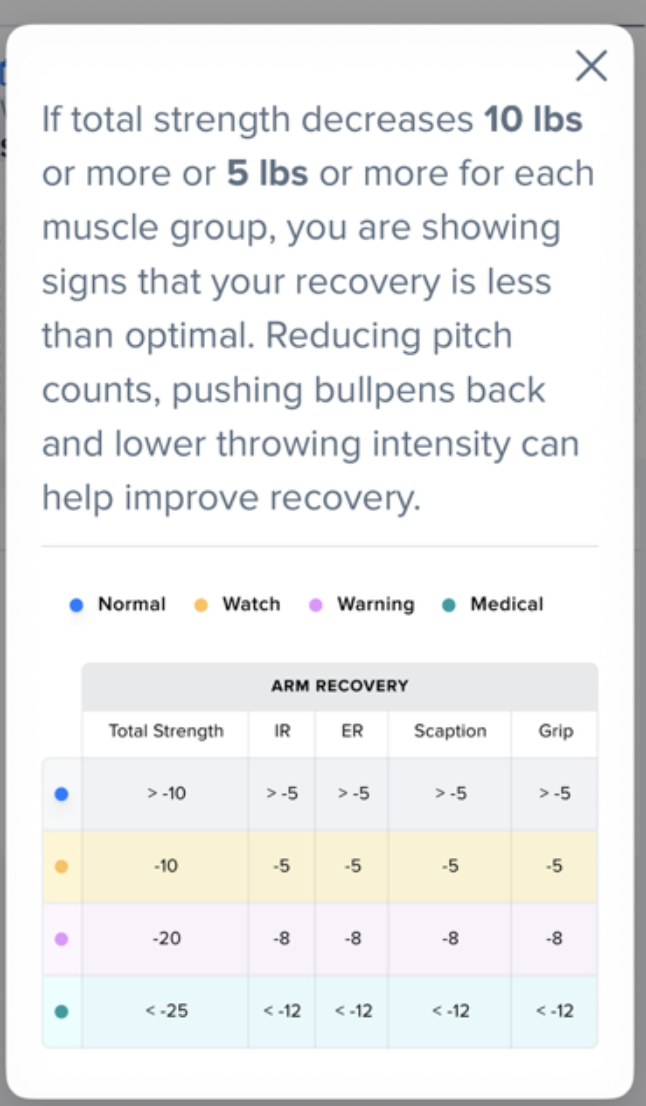
To see the alert system, click the “I” button beside the word “Normal” on the app interface. This athlete has been able to consistently capture neural activation in the throwing arm.
Takeaway Message
The real advantage of monitoring isn’t collecting more data.
It’s knowing when the data should change the plan.
A 5-pound signal may tell us to watch and recalibrate.
An 8-pound signal tells us to investigate more aggressively.
A 12-pound signal tells us that continuing without understanding the change is no longer appropriate.
And none of those numbers should stand alone. Pain, soreness, workload, throwing velocity, recovery history, and the athlete’s normal strength profile provide the context.
The goal isn’t to predict injury from a strength test.
It’s much more practical. Measure Change and then Make Changes. If you are not testing arm strength, then you won’t know how to do either with a data-led approach.
Strength Matters Most.
Ryan
Ryan@armcare.com