

Strength in Numbers – 272
Much of what now appears in the ArmCare app didn’t start as a software feature.
It began with research questions.
How strong should a throwing arm be? Does body size matter? What happens to strength after pitching? Can mechanics change how the arm fatigues? Do coaches have the information needed to individualize arm training? And can athletes reliably measure these qualities outside a sophisticated laboratory?
Four studies connect those questions to the way we monitor throwing arms today.
1. Strength needs context
The first study examined 242 professional baseball players and measured internal- and external-rotation strength. Importantly, strength was normalized to bodyweight rather than judged only by how many pounds an athlete could produce.
The results were eye-opening.
Position players demonstrated approximately 14–20% greater shoulder rotational strength than pitchers, while Latin American pitchers demonstrated 11.8% greater ER strength and 16.7% greater IR strength than North American pitchers.
That helped reinforce two concepts that eventually became important within ArmCare.
Absolute strength isn’t enough. Relative strength matters, as represented by our ArmScore. Shoulder balance between muscle groups also matters.
A 220-pound athlete shouldn’t necessarily be evaluated like a 160-pound athlete simply because they produce the same force.
This concept helped shape ArmScore, where we consider throwing-arm strength relative to the athlete, and Shoulder Balance, where we examine the relationship between opposing muscle groups rather than looking at strength numbers independently.
The bigger lesson for players is simple:
Don’t just get stronger. Make sure your throwing arm is getting stronger with you.
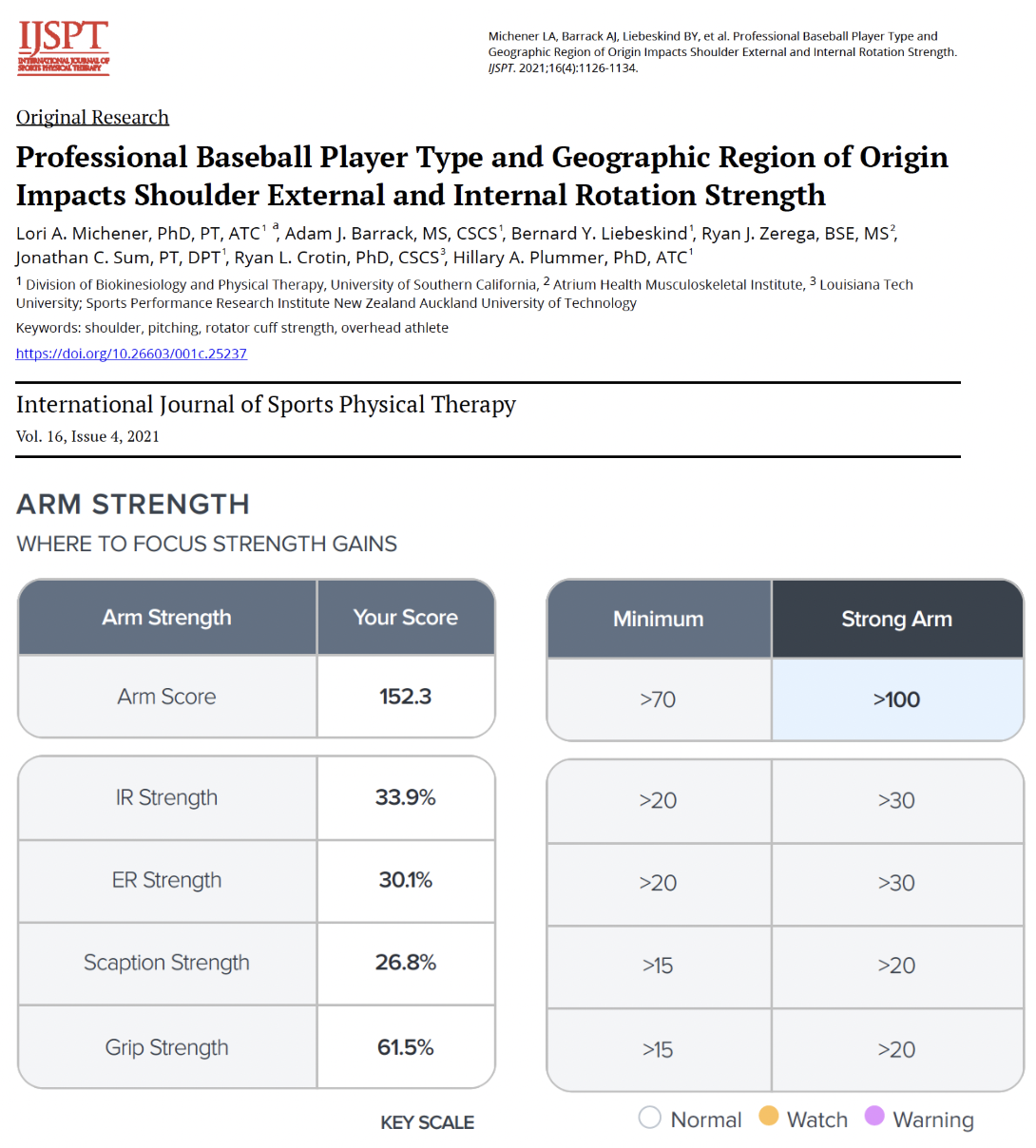
It’s one thing to have high absolute strength (the total number of pounds of force the arm can produce), but to compare strength levels and understand it relative to the body, you need to understand relative strength and the percentages of strength for each muscle group.
The ArmScore captures an athlete’s relative strength, which helps reduce injury risk and maximize performance.
2. Mechanics can change the strength demands on the arm
The next question went beyond how strong an athlete was when fresh.
What happens after he pitches?
In our grip-strength study, pitchers completed simulated 80-pitch games while stride length was deliberately altered. In the shorter-stride condition, dominant-arm grip strength declined significantly from 45.1 kg before pitching to 43.2 kg afterward.
Why does that matter?
The forearm musculature contributes dynamically to medial-elbow stability. When lower-body mechanics change, energy transfer through the kinetic chain can change, potentially altering what the throwing arm is asked to do.
But another observation was equally important – not every athlete responded to pitching by getting weaker. Individual post-throw responses varied, which is exactly why testing only when an athlete is fresh tells us only part of the story.
That concept helped shape the Post Exam.
We want to know: What did throwing do to this athlete?
Repeated post-throw measurements can then be compared with fresh strength to establish an individual recovery pattern. Instead of assuming every athlete requires the same recovery period, we can watch how quickly strength returns toward that athlete’s normal level.
That becomes especially interesting when we combine strength with velocity.
A pitcher may begin competition with an appropriate Strength-Velocity Ratio. But if throwing-arm strength falls while velocity remains essentially unchanged, he is now producing similar output with less measured muscular capacity.
The radar gun may not change even when the athlete producing the velocity has.
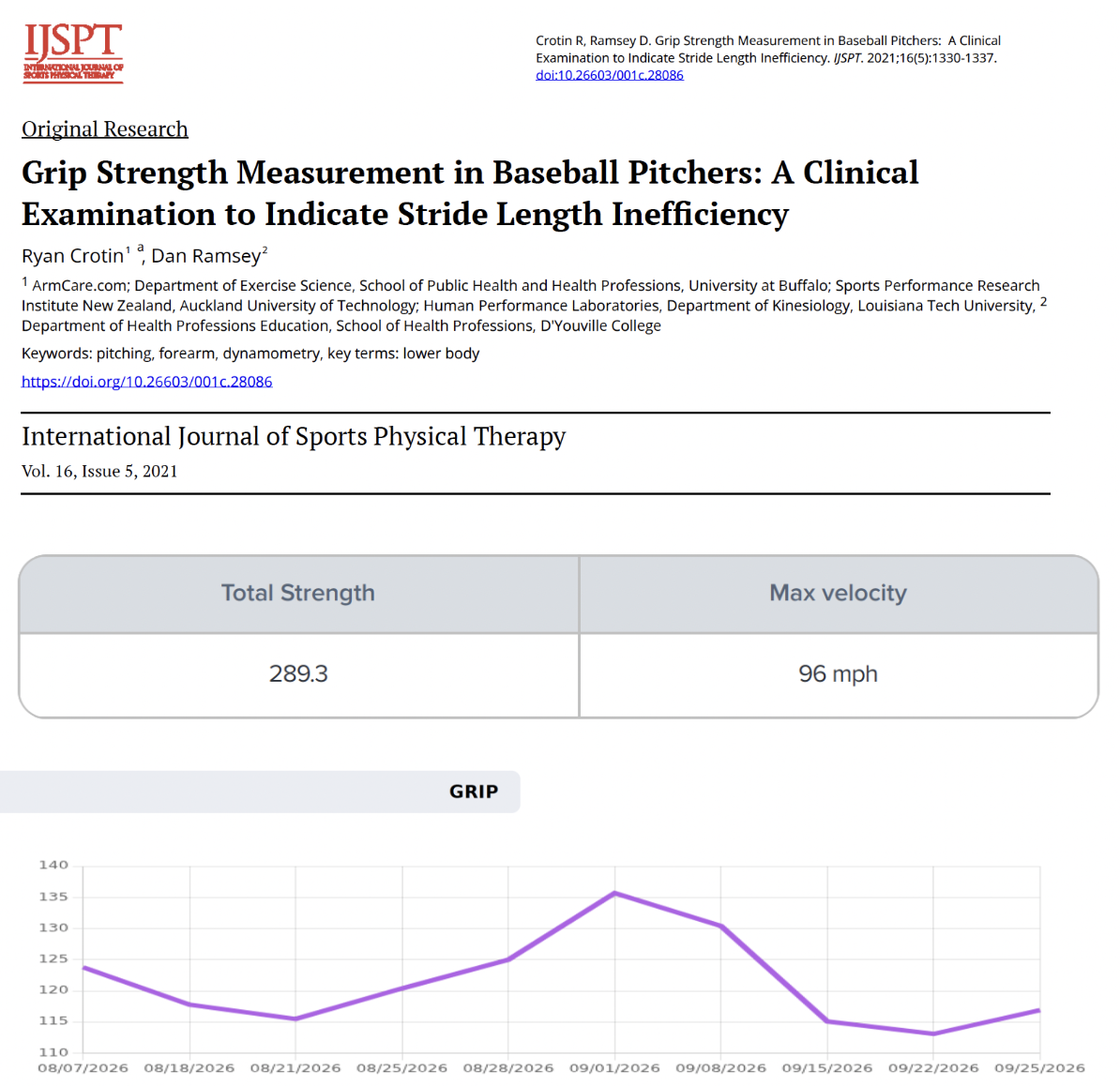
It doesn’t matter if you are a pitcher or position player; your grip strength does have an influence on throwing velocity and is a major component of the Strength-Velocity-Ratio.
If grip strength drops, you lose the catapult’s whip at the elbow, reduce friction on the ball, and the combination can lower arm speed, increase spin rate, and rush the ball out of the hand, affecting release consistency.
3. Coaches wanted individualization—but lacked the tools
Research then looked at what was actually happening in high-school baseball.
Among 654 responding coaches, 87.3% reported using an arm-care program.
Sounds encouraging.
But only 18.6% of coaches using arm care individualized the program to the needs of the player. Even more telling, 85.2% of all responding coaches said they would be interested in an arm-care screening tool to better inform their programming.
The problem wasn’t necessarily that coaches didn’t care.
They needed accessible information that could tell them what an individual athlete actually needed.
That finding helped reinforce why measurement needed to leave the laboratory and become something players and coaches could use themselves.
Arm care shouldn’t simply be:
Everyone grab a band and do the same exercises.
It should increasingly become:
Test → Identify → Train → Throw → Retest → Adjust.
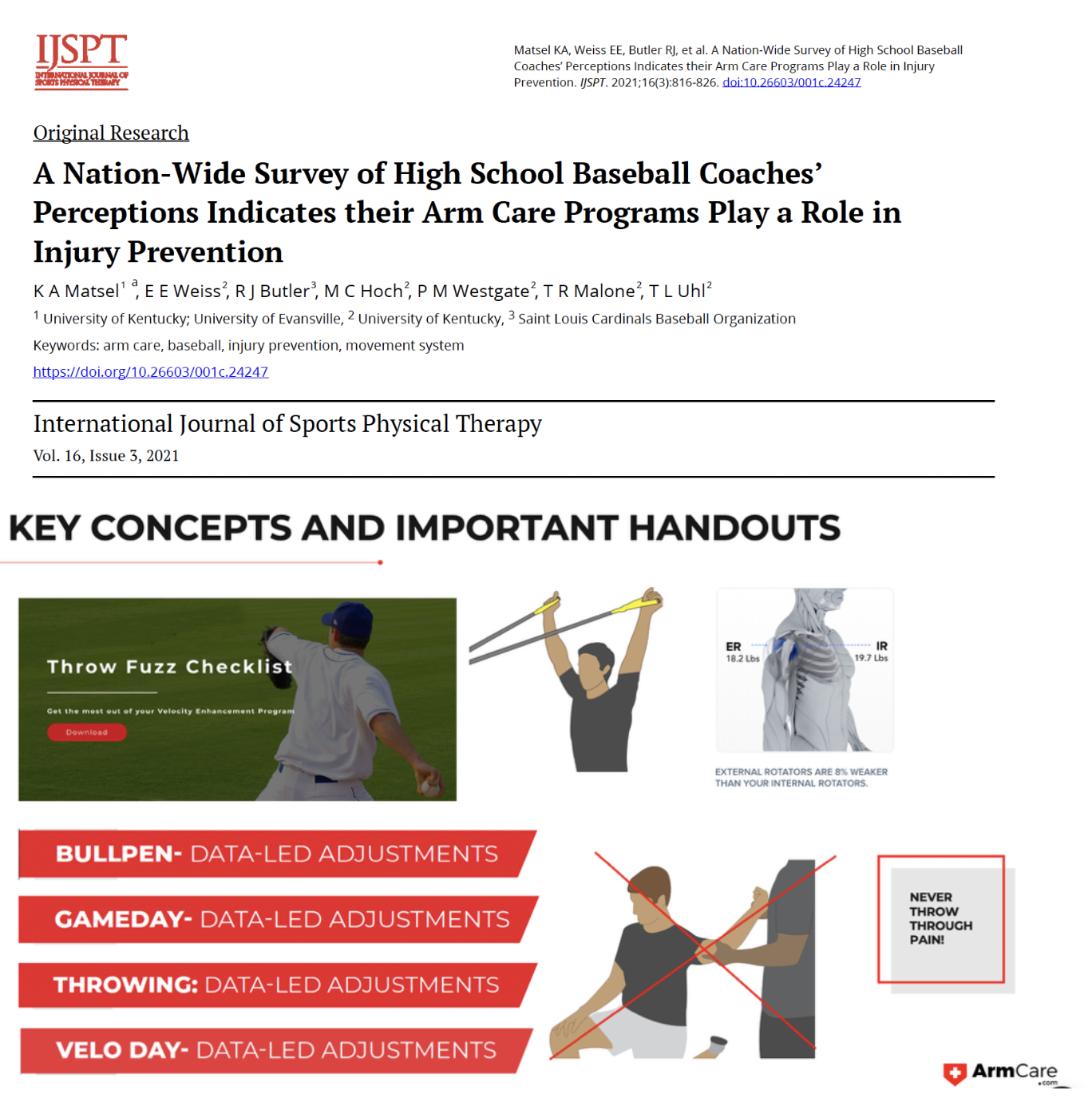
We have the tool, process, and resources to allow coaches to individualize and inform their programming – the research-inspired, important information that you can download right at the bottom of our website to understand the metrics, the benchmarks, and the training and workload management steps to take on an individualized level.
4. Could athletes actually measure strength themselves?
That brings us to the most recent study, and in my opinion, one of the most important ones.
Researchers had 51 high-school and college baseball players independently use the ArmCare system, then compared their strength measurements against traditional clinician-administered handheld dynamometry.
For strength, ArmCare demonstrated moderate-to-good test-retest reliability (ICC 0.73–0.87). Compared with handheld dynamometry, strength measurements showed correlations of 0.72–0.81 and agreement of 0.72–0.79.
That’s an important distinction: the study supported the strength-testing component to be strongly associated with more expensive clinical tools that require a clinician to run.
And that’s how science should work.
Test it. Learn from it. Keep improving it. And build a player-led approach.
Takeaway Message
Put these four studies together, and you can see how the questions evolved:
Q: How strong are professional throwing arms?
A: ArmCare measures strength relative to body weight and examines shoulder balance.
Q: What happens after pitching?
A: ArmCare measures functional response to throwing and recovery over time.
Q: Can coaches individualize arm training?
A: ArmCare gives objective information instead of relying on generalized programs.
Q: Can athletes collect meaningful strength data themselves?
A: ArmCare has a valid and accessible strength-testing system that players can run.
The future of arm care isn’t simply doing more exercises.
It’s knowing what your throwing arm needs—and knowing when that need changes.
Strength Matters Most.
Ryan@armcare.com