Strength in Numbers – 259
When people talk about a “strong arm,” they usually think about velocity.
But at ArmCare, we think about capacity.
A truly strong throwing arm isn’t just capable of producing force—it can repeat it, recover from it, and stay healthy throughout an entire season.
One of the simplest ways to understand this is through ArmScore, which measures throwing arm strength relative to body weight.
An ArmScore of 70 represents our minimum benchmark, while elite throwers often exceed 100% of their body weight in measured arm strength.
Some exceptional athletes even reach 120% or more, meaning they can generate more force with their throwing arm than they weigh.
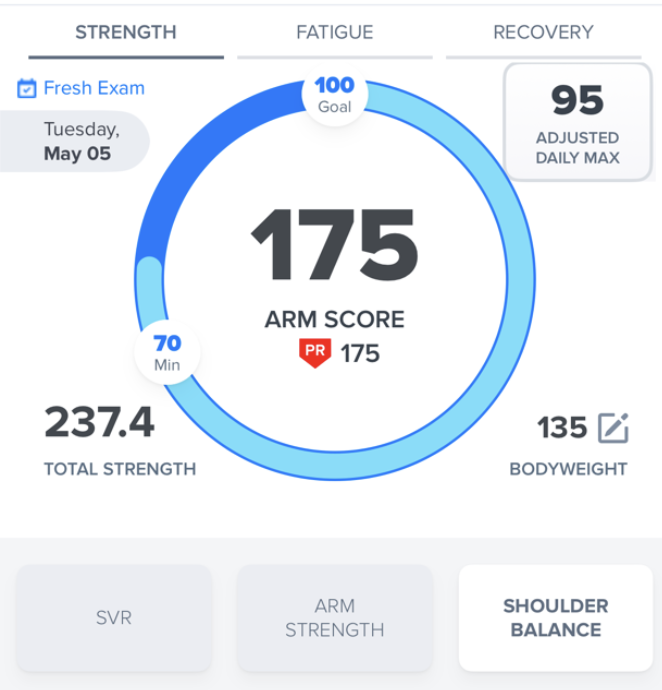
An example of a strong arm. The arm is scaled relative to the body size. You can see that the arm produces a force that is 75% of body weight and approaches 2x body weight. The arm shows strong recovery and minimal fatigue with increased pitch counts. This is what we want to see, and the shoulder balance is only slightly off, and that’s the place to concentrate.
Shoulder Balance Matters
But strength alone doesn’t tell the whole story.
A pitcher may produce tremendous force, yet still be at risk if that strength isn’t supported by good recovery, low fatigue, and balanced shoulder function.
After every high-intensity throwing session, we want to see less than a 10% drop in strength.
Larger decreases tell us the arm is becoming fatigued and may not be prepared for additional workload. Strong athletes who recover quickly can tolerate more training, pitch deeper into games, and return to competition sooner. The example above confirms these statements.
The final piece is one of the most overlooked.
The muscles in front of the shoulder accelerate the arm, while the muscles behind it stabilize and decelerate it after ball release. If one side becomes significantly stronger than the other, the shoulder loses its natural balance.
Even an athlete with an elite ArmScore and excellent recovery can increase stress on the shoulder and elbow if these muscle groups aren’t working together.
That’s why our training isn’t simply about adding more exercises or chaos for the arm. We continually adjust training volume so weaker muscle groups receive more attention while stronger areas are maintained. Building balance is often just as important as building strength.
The goal isn’t simply to throw harder or have the absolute strongest arm.
The goal is to build an arm that can generate force, resist fatigue, recover quickly, stay balanced, and remain available and consistent whenever your team needs you.
Because the strongest arm isn’t always the one that throws the hardest—it’s the one that’s still throwing hard when the season matters most.
Learn more about the ArmScore in the video below and how the data qualifies who has a strong arm and who does not.
Keep raising your arm strength because Strength Matters Most.
Ryan