S
Strength in Numbers #159
When it comes to the throwing arm, the winged scapula is a problem. Time will only tell just how much of a problem it is, but I am going to tell you a true story from an event I put on for 16 dedicated athletes and a couple of their younger brothers.
The event focused on baserunning and outfield play, two things that I am wildly passionate about, and I have significant playing and coaching experience. Each year in Spring Training, I worked alongside baserunning and outfield coaches and truly had a chance to provide interesting perspectives for the best coaches and players in the game.
There are parallels between baserunning and outfield play. You need to keep your feet in motion. In the outfield, we call this a prep step. On the base paths, you have prep steps when taking a secondary lead, as moving from a dead stop impacts jump times.
One of the strongest heuristics, “rules of thumb,” if you will, is “KNEES AND TOES IN THE DIRECTION YOU WANT TO GO.” Far too often, I see outfielders jockey in their first steps. They cannot head snap and get their body around, and then they open to the ball, which alters their routine and absolutely kills their closing speed on the baseball.
On the basepaths, you can see players who do not follow this ethos with mistimed steal starts, extremely poor secondary leads, tag-up positioning, and acceleration at third base. Watch a 12-year-old tag up on a ball to left field, and you will catch my drift—they stand at third base with their entire bodies facing right field. Knees and toes are not in the direction they want to go.
Video demonstration of the head snap. This keeps the knees and toes in the direction the athlete needs to continue to go to close in on a deeply hit baseball.
THE LONG HOP
Catchers are incredible athletes. People do not realize their flexibility, explosive strength, and throwing arm power, coming out of a static position to drive a bullet into an infielder’s glove. But when it comes to handling outfield throws, they often come up unsuccessful. One of the issues is the outfielder’s decision to put air under the ball and try to throw it the entire way. This leads to a short hop at the feet of the catcher or backs him way off the plate, resulting in a loss of defensive runs saved as the backside runner gets to second if the ball doesn’t take the catcher in front of the plate with it being thrown in the air.
Here’s where you can really coach and improve the team’s success and give your young catchers confidence in making outs at the plate – it’s called the long hop, a throw that lands about 10 feet in front of the catcher and skips into his or her mitt. There’s not much air under the ball; the throw is low and can be intercepted by a cutoff man and, providing the team a better chance at keeping the backside runner at first as they cannot determine if the ball will be airmailed.
Video of Bryce Harper making a long hop throw to the catcher. This keeps the ball low to the catcher’s glove and provides cut off men a chance to throw out backside runners.
I ask kids who pitched the day before to only throw 1-2 long-hops after a warm-up and head to the plate to be a catcher. Using the ArmCare platform with the new 1-rep test feature for showcases, you can easily identify players with arm fatigue that may not be recovered, especially for players with premium subscriptions.
There are 3 big-picture items to successfully throwing out a runner at home plate:
- You collect the ball quickly
- You get the ball out of your hand quickly
- You have ride and tight spin on the ball from a ¾ to over the top release point
UNDERLYING ISSUES THAT PREVENT THROWING ARM ELEVATION
While evaluating throws, I noticed one athlete with a side arm delivery. Very strong arm but lacked the ability to throw through a doorway, which most outfielders do to keep a tight line in the direction of their throws. This athlete was very rotational, and I suspected what I feared – he had a winged scapula and has a functional upper cross syndrome situation. As the other boys made strong throws to home, I spoke to the athlete. He said that his arm had been hurting him off and on for a while and that he is also a pitcher.
After the throwing event, we all went over to the fence and worked on critical arm care drills that I educate 5-12 year-olds on and familiarized the players with how to use Crossover Symmetry bands. It was apparent to me when he was standing at rest that his shoulder blades winged and when I went to assess how much, I could get end of my fingers underneath both which tells me work had to be done.
UPPER CROSS SYNDROME
Upper Cross Syndrome (UCS) is a postural disorder characterized by tightness in the upper trapezius and levator scapulae muscles (upper back and neck) coupled with weakness in the deep neck flexors and lower trapezius/rhomboid muscles. This imbalance creates a crossed pattern of overactive and underactive muscle groups, leading to poor posture and musculoskeletal issues.
Common Symptoms Appearance
– Forward head posture
– Rounded shoulders
– Elevated and protracted scapula
– Increased cervical lordosis and thoracic kyphosis
Baseball players, especially pitchers and catchers, are prone to UCS due to the repetitive overhead and forward motions required in their sport. This syndrome can lead to several complications:
1. Decreased Performance: Poor posture and muscle imbalances can affect a player’s throwing mechanics, reducing the efficiency and accuracy of their throws.
2. Reduced Range of Motion: Tightness in the chest and upper back muscles can limit the shoulder’s range of motion and upward rotation of the scapula, which is essential for throwing and batting.
3. Injury Risk: UCS is associated with an increased risk of shoulder impingement, rotator cuff injuries, and elbow issues such as ulnar collateral ligament (UCL) injuries. This is because the altered biomechanics place undue stress on these structures during the throwing motion.
4. Chronic Pain: Persistent muscle imbalances can lead to chronic neck, shoulder, and upper back pain, which can further impede performance and recovery.
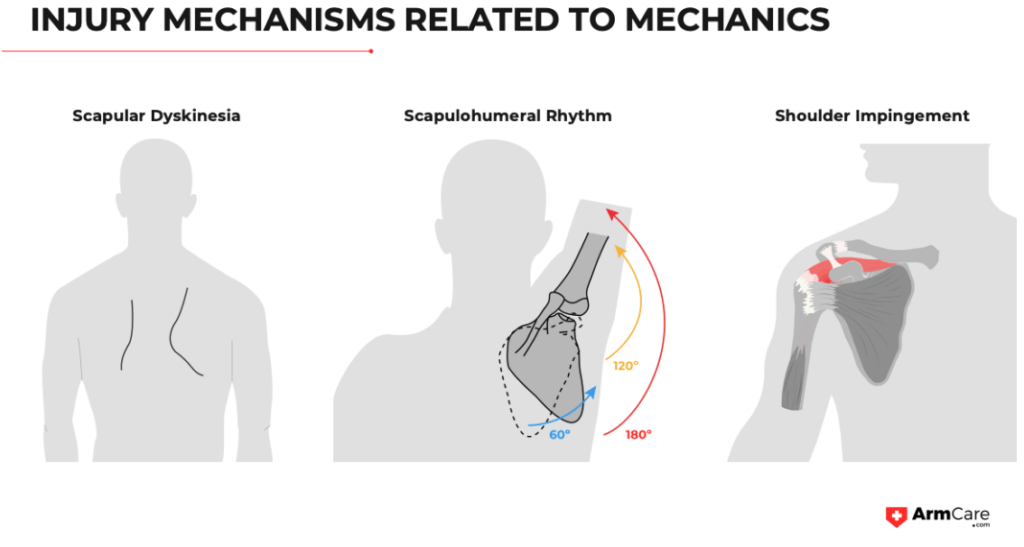
When the shoulder blade is winged such as the image on the left, it affects scapulohumeral rhythm between the shoulder blade and the humerus (upper arm bone). For every 1 degree of upward rotation of the scapula, the upper arm increases elevation by 2 degrees. To raise the arm overhead and clear space under the acromion (flat end point of your shoulder), the shoulder blade must rotate roughly 60 degrees. If the shoulder blade is restricted, it results in dropping the arm through the throw. Shoulder impingement occurs when the shoulder blade does not rotate upward, and the elevation of the humerus pinches the superior rotator cuff fibers under the acromion.
Addressing Upper Cross Syndrome
Addressing Upper Cross Syndrome
1. Postural Correction: Educating players about proper posture can help mitigate the risk of UCS. They are playing video games and, on their cellphones, and slouch.
2. Strengthening Weak Muscles: Exercises such as chin tucks can help strengthen muscles of the neck. There’s also a whole host of exercises on the ArmCare app that attack the lower trap, serratus and rhomboids.
3. Stretching Tight Muscles: Stretching the pec muscles can help open up the chest and improve shoulder positioning.
ONE OF MY SECRETS TO CLIP YOUR WINGS
One of my favorite approaches to training the serratus anterior is dual-vector inverted co-contraction training, actually putting the athletes hands on the ground and having the shoulder blade work in reverse fashion (shoulder blade moves around fixed arms in upward rotation, rather than arms moving around fixed scapula). The other is protraction flys emphasis extending the endpoint of the press as far as you can take it until the shoulder blade becomes flush with rib cage and the inferior boarder of the scapula cannot really be seen.
Open this link to get a full rundown of inverted closed chain contraction training. Start with very simple progressions before attempting more advanced exercises.
Open this link to see a variation of the protraction fly that is presented in detail in our Certified ArmCare Specialist Course.
To sum this up, the lens for ArmCare.com should not be a tech solution exclusively for pitchers. As you can see, defensive play requires a strong throwing arm and position players, like pitchers need a balanced shoulder, one that has proper scapular positioning, not fatiguable and recovers well.
By taking care of your position players, you will help your pitchers, as losing a key defender will cause them to have to work harder and have a greater probability of having more runners on base which adds stress to them.
As I always say, STRENGTH MATTERS MOST.
Ryan